Mar 15, 2023
Remebering the origins of White Label Space in Japan
Nov 29, 2022
ispace Ready to Send HAKUTO-R Lander to the Moon
Oct 24, 2011
WLS Japan Engineering Meeting


Sep 26, 2011
WLS Japan Fun Meeting 3 - Part 1
In this video, chapter 1, Takeshi Hakamada, the CEO of White Label Space Japan, discusses the recent press conference that was organized in Tokyo to unveil the rover prototype, as well as explaining some of the background motivations of the GLXP.
May 21, 2011
Official Fan Meeting to be Held in Tokyo
Do you want to be part of a revolution in private sector lunar exploration?Nine months after the official White Label Space kick-off event in Japan, the team has reached the end of the planning phase and its spectacular moon mission is about to get underway.
This event will begin with an overview of the team's activities, and then move into an open discussion where everyone is free to interact with the team members, exchanging opinions and ideas or to ask questions about mission. Splinter meetings on specific themes will also be held. The aim of the discussions is to formally adopt the team's mission plan.
Share your ideas, take responsibility and be part of a unique team as it undertakes the first ever open space development. This is a once in a liftetime chance to see dreams becoming reality!
The Google Lunar X PRIZE is a race for unmanned lunar exploration with US$30 million in prize money sponsored by Google. The competition involves 29 official teams from 18 countries, and White Label Space is the only team in Japan. In addition to aerospace engineering professor Kazuya Yoshida of Tohoku University, the team also includes professionals in PR and advertising and management consultanting, as well as young researchers working in diverse fields of the arts and sciences. So to attend this event you are not expected to be a rocket scientist or astrophysicst - creative contributions are sought from everyone!
Please join us at this participatory event and become part of the new wave of open space development!
Programme
Title:
Google Lunar X PRIZE Team Official Fan Meeting in Japan
An official fan event for the Japanese team participating in the US$30 million competition for robotic lunar exploration.
Date and Time: (to be confirmed)
Saturday, June 4th, 2011
Doors open: 17:30
Start: 18:00
End: 20:30
Venue:
TOKYO CULTURE CLUB
Address: 3 1-chome, Koto Ward, Tokyo
(Five minute walk from Yurikamome Station)
Contents:
GLXP overview and introduction of the activities of the mission team. Participants can exchange ideas freely with other members and questions and ideas unmanned lunar exploration mission. Thematic group discussions will also be held.
Presentating:
Takeshi Hakamada, CEO of White Label Space Japan
Other key members of the team will also be on hand for questions and discussions
Tickets:
Advance tickets ¥2,000
Tickets at door: ¥2,500
(Food and drinks are provided for an additional ¥600)
Notes:
Admission is strictly limited to available seating according to numbered tickets.
Food and drinks will be served during the event, but billed seperately (beer ¥600,soft drinks ¥390
Contact:
events@whitelabelspace.com
May 14, 2011
Rover Supplier - Ono Denki
In mid-January 2011 White Label Space asked Ono Denki to produce the suspension sub-assembly of the team's prototype rover, currently under development at Tohoku University's Space Robotics Laboratory. The work was delayed by the Sendai Earthquake which affected certain parts suppliers, but Ono Denki successfully completed hardware by the 11th of April. The final delivery and inspection took place during a visit by WLS Chairman Dr Andrew Barton and Professor Yoshida of Tohoku University, who is responsible for developing the team's rover.
Ono Denki was founded in 1938 and has a long history. The company's CEO is Mr. Ono (pictured right). He is the third generation of his family responsible for the business. A key strength of Ono Denki is the capability to support the entire process from design, machining, assembly, board, wiring, and software development all the way through to final testing and evaluation. The company has several engineers specialized in each of those phases. Thanks to the close communication among engineers involved in each process, Ono Denki provides very high quality to its customers.Ono Denki has also provided space development-related equipment for JAXA (Japanese Aerospace Exploration Agency) and many others. In 2010 in an article by Diamond Weekly, a popular business magazine in Japan, Ono Denki's activities in the space industry were highlighted.
A common belief in Japan these days is that that small companies are in danger of disappearing due to a lack of people interested in carrying on the business. This leads to a fear that the nation's technology level will get suffer due to the loss of know-how. However, steady stream of excellent young engineers who are receiving guidance and mentoring from skilled personnel ensures that Ono Denki will continue to thrive into the future.
Apr 27, 2011
White Label Space East Meets West
Apr 20, 2011
White Label Space Japan fund raising for Disaster Relief
First, we would like to express our sincere sympathy to all those affected by the Tohoku-Pacific Earthquake, Tsunami and following disasters.
We have started collecting relief donations from 7th April 2011via “JustGiving”, UK’s first online fundraising service, for the affected people in Japan by the series of disaster. White Label Space Japan is the only team participating in the Google Lunar X PRIZE from Japan, which will award a total of $30 million in prize money to the first privately funded teams to land a robot on the surface of the Moon and operate specific missions.
As a representative of Japan, we are leveraging our GLXP network with 29 teams participating from around the globe and collecting relief donations not only from Japan, but also the whole world. We will donate all collected funds to CIVIC FORCE, a non-profit association that provides prompt and effective disaster relief to large scale natural disasters in Japan.
Sep 20, 2010
White Label Space Japan Office is GO!
Key members of the Japan Office were present including Professor Kazuya Yoshida (pictured below), Takeshi Hakamada and Taro Asazuma. Video messages from Peter Diamandis and Andrew Barton were also played.
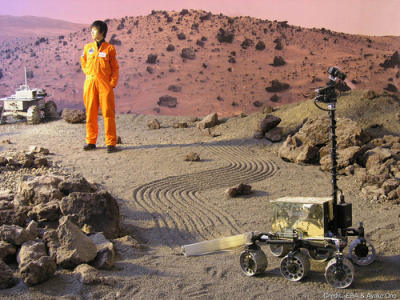
Guests of the event were also invited to try their hand at remotely writing Japanese characters on a simulated lunar surface (see below), inspired by the lunar zen garden concept developed by White Label Space team artist, Ayako Ono.
Japanese speakers can watch the UStream Video of the event (fast-forward to about 17:30 for the start of the presentations).
Jan 17, 2010
WLS Presents at University of Tokyo
Professor Kazuya Yoshida, the lead engineer of the Rover and Dr Andrew Barton, lead engineer for the Lander, presented to a crowd of over 50 including many prominent members of Japan's space industry. Also sharing the podium was Misuzu Onuki, CEO of NewSpace Consultants and prolific space 2.0 author explained the benefits and challenges of private space exploration with a particular emphasis on increasing Japan's involvement in this exciting field.
Dr Peter Diamandis from the X PRIZE Foundation also joined the proceedings remotely by sending a video email welcoming Japanese involvement in the Google Lunar X PRIZE.
The event also served as a kick-off meeting for the Japanese branch of White Label Space with enthusiastic brainstorming continuing until the early hours of the morning.
White Label Space aims to harness the advertising budgets of some of the world's biggest brands to achieve its Google Lunar X PRIZE mission and the connection with Japan is very important since that country has many of the world's top technology firms and biggest advertisers. The team is planning to develop a "made in Japan" rover that will provide sponsors with a strong platform to reach out to the general public, sending a message of technological advancement and commercial leadership.
May 3, 2009
Ikegami Camera Shows Full Earth from Moon
Jan 31, 2009
Tohoku University's SPRITE-SAT Successfully Launched
The SPRITE-SAT spacecraft designed and built by Tohoku Univeristy, a partner of White Label Space, was successfully launched into space last week on a Japanese H-IIA rocket. The satellite was inserted in the prescribed orbit and radio signals from the satellite have been received at the ground station in Tohoku University, and have confirmed that the satellite is in good health.SPRITE-SAT has now started its mission to observe Sprites and Terrestrial Gamma-ray Flashes (TGF). The spacecraft was developed by the faculty and students of Tohoku Univeristy, with technical support from external mentors experienced in satellite development. Students played a leading role in the assembly and testing of the spacecraft, giving a unique opportunity for hands-on education in space science and space engineering.
Onboard the satellite was a minature gallery of art, etched onto a silicon wafer by photolithography, making this mission also one of the first art exhibitions in outer space.
![]()
Tohoku University, led by Professor Kazuya Yoshida, will use the experience gained from SPRITE-SAT to develop the rover for our Google Lunar X PRIZE (GLXP) mission, which will be a small rover capable of travelling at least 500m across the lunar surface and capturing hi-definition videos and photographs for transmission back to Earth.
Jan 19, 2009
Crowd-Sourced Microblogging Space Mission
For those who find that Twitter is just not quite cool enough, now a Japanese non-profit organisation called the Kansai Space Initiative (KSI) has set up space project that will allow microblogging via a space-based server in the form of its 50kg satellite called KaSpl-1, which is due for launch as a secondary payload in 2013. There will be an on-board camera pointing at a digital screen that can display emailed user messages while in orbit... useful hey?
The project will also feature a crowd-sourcing element in that anyone who is interested can pay 3,000 yen (US$33) to get their say in how the project is run. Presumably the launch costs will be paid by those contributions, meaning that about 3000 people will be needed to pay (calculation based on launch cost of $2000/kg times 50kg = $100,000).
How many twitter-holics will be interested financing this project?
(Sources: TechRadar.com article, and Dick's Rocket Dungeon)
Oct 5, 2008
Greatest Space Ads Part VIII - Cosmofon's Signal Reaches Space
Previously in our Greatest Space Ads series:
- Part I - Heinekin on Mars
- Part II - Pizza Hut on the ISS
- Part III - Pepsi on MIR
- Part IV - Space Food Sticks
- Part V - Space Golf by Element 21
- Part VI - Martians with Hewlett Packard Printers
- Part VII - 7Up Spaceflight Competition
Sep 12, 2008
Lost In Translation - Don't Rely on Babelfish

And by the way, the correct translation for the chinese writing in the picture is "Restaurant".
Aug 30, 2008
Moon 2.0 Video - Japanese Version
We've made a Japanese subtitled version of the Google Lunar X PRIZE promotional video, Moon 2.0 - Join the Revolution.
See: Moon 2.0 in Japanese
Note, there is a small arrow on the bottom right corner of the YouTube viewer it enables/disables the subtitle captions (see How to Show YouTube Subtitles).
This is a brand new feature in YouTube.. let us know what you think about it.
If you want a translation in your language, send us an email at: thestorcargo@gmail.com
Aug 11, 2008
Tohoku University Space Robotics Lab to Develop GLXP Rover
- an IEEE prize-winning contribution to Japan's free-flying space robot project ETS-VII (similar to the Orbital Express mission of the USA)
- contributions to design of the sample acquisition mechanism and touch-and-go sampling sequence of the Hayabusa asteroid sample return mission
- 1st and 2nd prizes at the 2006 ARLISS comeback competition
- development of the 50kg SPRITE-SAT, will be launched on JAXA's H-IIA rocket in early 2009
Jul 24, 2008
First Art Exhibition in Outer Space
Tohoku University, Japan, is now developing a small satellite, named SPRITE-SAT, with launch planned for January 2009. The main mission of the satellite is a scientific study of lightening phenomena above the cloud layers but using this opportunity, they are also organizing the first art exhibition in outer space!
To take part in this exhibition you should submit monochrome digital pictures, which will be shrunk to a size of 1mm squares arranged as a mosaic on a silicon wafer fabricated using photolithography technology. The photolithography and etching process will be done on a standard silicon wafer, cut into a 3 cm by 3 cm piece, which will be exhibited in orbit attached on the top of an antenna boom on the top of the satellite. The artworks will also be exhibited on a special web page.
Submitting your artwork:
Please submit a digital drawing in 500×500 pixels, or a line drawing 500×500 pixels resolution. Black and white, no halftones. Submit as a digital file which can be displayed in 10 cm square on a computer screen.
Deadline of submission: August 10, 2008
Please send your submission or any questions to Prof. Kazuya Yoshida:
yoshida@astro.mech.tohoku.ac.jp
Jul 23, 2008
Japanese Lunar Exploration and the Google Lunar X PRIZE
But what a pity that the GLXP website has such a poor Japanese page. It appears that the site has little more than a translation of the main press releases and some information about the teams and key people. Furthermore, after exhaustive seraching we were unable to find a Japanese version of the GLXP promotional video - "Moon 2.0, Join the Revolution".
If the X PRIZE foundation and Google want to engage the large and affluent Japanese appetite for space-related issues they should really invest a bit more money in providing their content in the Japanese language.
Jun 1, 2008
Space Art:
Since 1996 Ayako Ono has been exploring humanity's frontiers in the cosmos and imagination with her space art. The role of art is to stimulate the senses and imagination, broaden perceptions, and explore new perspectives. Sometime soon future generations will live far from the earth's surface. The resulting changes to the living environment will necessarily affect a radical transformation in common values. Space Art will help us prepare for the creation of these new values, and help answer the fundamental question of how human beings will evolve with these new values. In tackling this complex proposition, we will explore and invent new notions of beauty in cosmic space, through the interaction between various values systems.