Jun 4, 2010

Congratulations SpaceX - You Are an Inspiration!

June 4th, 2010 - SpaceX has successfully launched its Falcon 9 rocket into low Earth orbit on the very first mission. The launch was broadcast live on the internet for all the world to see. The image below was snapped off the video published on the internet and shows the ignition of the rocket's second stage (click on image to watch video).

A brief timeline for the key events off the Falcon 9 development is shown below the image. Amazingly the complete development of the vehicle from the first public announcement to the first orbital insertion took less than 5 years - a pretty a darn impressive feat!

  • May 5, 2004 - Elon Musk testifies to the U.S. Senate Committee on Commerce, Science and Transportation stating that "Long term plans call for development of a heavy lift product..."
  • September 8, 2005 - SpaceX formally announces the Falcon 9 describing it as being a "fully reusable heavy lift launch vehicle"
  • April 12, 2007 - SpaceX announces it had completed the primary structure for its first Falcon 9 first-stage tank
  • October 17, 2007 – SpaceX announces successful completion of the Critical Design Review for the first Falcon 9 / Dragon mission under NASA's Commercial Orbital Transportation Services (COTS) demonstration program
  • July 31, 2008 - First successful multi-engine firing test of Falcon 9 first stage
  • January 2, 2010 - Successful full duration orbit insertion firing of the Falcon 9 second stage
  • March 9, 2010 - First static firing test of the first stage on the launch pad
  • June 1, 2010 - Successful completion of testing of the Flight Termination System
  • June 4, 2010 - Falcon 9 successfully launched on the second attempt of the day

Greatest Space Ads - Coke and Mentos Rocket Propulsion

Coke and Mentos have teamed up to produce this video showing a bunch of rocket scientists using their respective products as propellants for a human-carrying vehicle. Although the specific impulse is not as high as other more common rocket propellants this approach certainly gives impressive visuals! There is also a nice shot of the scientists looking up at the Moon at the end of the video.

Marketers are increasingly looking to these kinds of viral video ads as a cheap alternative to traditional media. Video sharing sites like YouTube make it possible to reach a very large audience at no cost beyond the production of the video itself.

At White Label Space we have also been looking at how we can use the new media approaches to fund our activities for the Google Lunar X PRIZE. We aim to provide our sponsors with unique advertising opportunities that convey fresh and exciting messages at a competitive price.

May 25, 2010

Jean-Paul Godon

Jean-Paul Godon is an advisor to White Label Space. He is an international business development consultant specialized in advanced technologies.

For several years he was in charge of international development for several major French aerospace companies including SNECMA and EADS, and also has extensive experience developing business in other highly technical fields across the European Union, the USA, the Middle East, Asia and Russia. He was one of the founders of the European Hydrogen Association (EHA) as well as the French Hydrogen Association (AFH2).

He obtained a degree in business administration at the French business school ESCP-EAP and later he received a Fulbright Scholarship to study international relations at Johns Hopkins University, Paul Nitze School of Advanced International Studies (SAIS).

***

May 19, 2010

Kirby Ikin

Kirby Ikin is an advisor to White Label Space.

Kirby is Chairman of the National Space Society and Managing Director of Asia Pacific Aerospace Consultants (APAC), which offers consulting services to the commercial space industry including market analysis, industry analysis, risk management and insurance advice.

Prior to his role with APAC he worked in the space insurance, risk management, and commercial space fields for over fifteen years. His career included over ten years as a space insurance underwriter and Managing Director of GIO Space, as will as being the Director of Commercial Operations at the Asia-Pacific Space Centre (APSC) with the aim to introduce the Russian Aurora launch vehicle to the commercial launch market. He was directly responsible for managing the insurance requirements for both APSC and its launch customers.

***

May 16, 2010

PCB Design for Engine Throttle Controller

Lunar Numbat is now getting close to construction of the first full working prototype of the throttle valve assembly that we will use on our lunar lander engine. The valve assembly will include a digital control system, a custom design by the Lunar Numbat team..

Remember, you can follow the details of their technical progress online because Lunar Numbat is an open source effort!

This PCB design was recently created by Luke Weston and the team is now preparing to build it in hardware. It contains a microcontroller that drives the electric motor as well as an interface for the CAN bus that forms the backbone of the vehicle's avionics.


Other components of the valve assembly include;
***

Martin Lemmen

Martin Lemmen is the lead thermal design engineer of the White Label Space team, responsible for the conceptual and preliminary design decisions as well and overseeing the detailed thermal analyses conducted by other members of the team.

Martin is a thermo-mechanical engineering specialist with over twenty years experience in the Dutch space industry. During his career he has worked on numerous advanced space projects including items such as mirrors, optics boxes, future launchers, the Ariane V launcher and thermal protection systems for re-entry vehicles.

Martin holds a Master of Science in Aerospace Engineering from the Delft University of Technology and is author or co-author of six technical papers and one European patent application. He also acts as mentor for thermal engineering aspects of student design synthesis projects the Technical University of Delft.

***

May 7, 2010

Engine Throttle Valve Activated on Lab Bench

Luke Weston from our open source partner Lunar Numbat has made this video showing progress on the engine throttle valve. The ball valve's position can now be set via software commands sent to the servo drive board.

The valve's first flight test will be on the AUSROC 2.5 rocket in preparation for use on our GLXP lander.

Apr 26, 2010

Greatest Space Ads - SONY and INTEL Launch the Rocket Project

Linking the themes of space and education, SONY and INTEL are sponsoring The Rocket Project. The basic recipe of the project is to take a bunch of smart secondary school kids and put them together in a team to design, analyze and build a high altitude sounding rocket capable of reaching an altitude of 160km (528,000 feet). A YouTube video about the project is embedded at the end of this post.

Of course the students are assisted in their work by SONY VIAO notebooks powered by INTEL processors.

The leader of the project, also acting as teacher/mentor for the students is Thomas Atchison, a high-power rocketeer and founder of the Association of Rocket Mavericks. Tom also has strong links with the technology industry from his 25+ years of experience as an executive and entrepreneur in Silicon Valley.

It's interesting that these major global brands are recognizing the public interest in challenging space-related projects. Our team of space professionals plans to harness similar types of public interest to held us achieve our Google Lunar X PRIZE mission.


The ad agency behind the project is 180 LA.

***

Apr 22, 2010

Mobility? We've Got it!

In this video our partner the Tohoku University Space Robotics Lab demonstrates the mobility of the El Dorado II rover on the test course at the 2009 IEEE ICRA Planetary Rover Challenge.

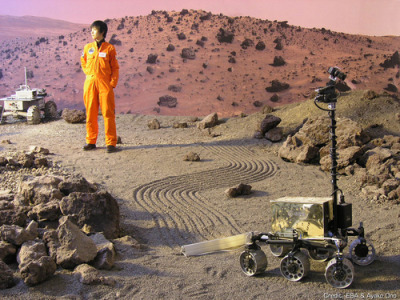
The El Dorado II rover was developed at the Space Robotics Lab under the leadership of professor Kazuya Yoshida and forms a fully functioning prototype of the mobility subsystem for the lunar rover in our Google Lunar X PRIZE (GLXP) mission.

The test begins with a simulated egress from a platform representing a lander. First the rover rotates on the spot (using the wheel pointing motors). Then it descends the egress ramp, which is at the same angle as on our GLXP lander.


The rest of the video shows the rover driving autonomously across the obstacle course to the far corner. Then it returns to the starting point, up the ramp once again. As it proceeds, the rover generates its own digital map of the environment.

Apr 18, 2010

Greatest Space Ads - Yava Gold Strikes Back for Russia

After the fall of the communist system in the Soviet Union, Russian consumers were suffering an 'invasion' of higher quality western products marketed with slick modern advertising, a new phenomenon in Russia. Local brands were in rapid decline and profits were rapidly disappearing to the West. Then in 1998 the newly launched Yava Gold cigarette brand decided to 'strike back' by launching an ad campaign that brought back national pride to Russian consumers.

The ad pictured was part of the campaign. It shows a patriotic Russian cosmonaut painting the Yava Gold logo on the US Space Shuttle. The text at the bottom of the image reads "retaliatory strike".


In the 1990s Russian space missions were frequently being used as advertising platform for western brands (many of which are reported in earlier posts on this blog). Having cashed-up foreign brands using your nation's space hardware and cosmonauts as advertising billboards must have been quite humiliating to Russia's national psyche - a nation's space program is major symbol of pride after all!

"Yava" was the oldest cigarette brand in Russia and the "Yava Gold" brand was built upon that strong heritage. Ironically however, the financing for the development of the new brand actually came from British American Tobacco. In that era tobacco companies were finding it harder and harder to make profits in the west due to the heavy restrictions being placed on advertising as well as high taxes. Russia, the world's fourth largest tobacco market, was an ideal region of growth, and British American was quick to seize the opportunity in this formerly closed market.

This video is a documentary about the Yava Gold campaign.


References:
***

Apr 10, 2010

Supersonic Parachuting: Red Bull Stratos vs Le Grand Saut

Two teams are currently competing in an unofficial race for the first human parachute jump to reach supersonic speeds in the descent.

The current record height for a high altitude jump is 31.09 km (102,800ft), achieved on August 16, 1960 by Joe Kittinger, a retired United States Air Force Colonel. During his drop he reached a top speed of 988km/h (614mph), just below the speed of sound. But it looks like we are soon going to see the first parachute jump that breaks the sound barrier 1083km/hr (690mph).

Red Bull Stratos

In the Red Bull Stratos effort Felix Baumgartner (pictured left) plans to jump from a balloon at 36.58km (120,000ft). The team boasts a very nice website and an all-star project team. Oh, and don't forget the sponsorship of Red Bull, a brand well-known for associating itself with high-profile sports, extreme sports and record-breaking efforts. Another well-known brand, Nokia, is also providing a special application for its handsets that will enable the public to watch the event in real-time, even showing Baumgartner's pulse rate!

Le Grand Saut

In parrallel, another effort by a team consisting of French and Canadian members is preparing for Le Grand Saut (The Big Jump). In this effort, Michel Fournier (pictured right), a former colonel and paratroops instructor in the French army reserve will attempt to jump from a balloon at 40km (~130,000 feet). Le Grand Saut doesn't appear to have any major sponsors but it also has some quite impressive members from the medical sciences.

Le Grand Saut is planned for May this year whereas Red Bull Stratos has not announced the date of its attempt.

Parachute jumping from extreme altitudes is not just a publicity stunt. It also has important benefits for many other fields including medicine, science and technology. These types of extreme altitude parachute jumps can also simulate the ejections of astronauts from a high altitude rockets, quite important in this age of human sub-orbital spaceflight.

Scroll down this post to see a promotional video of the Red Bull Stratos effort as well as a nice picture and two CNN news pieces about a previous attempts at Le Grand Saut.


Apr 3, 2010

Lunar Numbat Progress on the Throttle Valve Controller

Our open source partner Lunar Numbat is working on the throttle valve controller for our lunar lander. See this blog post for their latest progress on the motor that will control the valve. The post also includes two videos of testing of the controller.

Lunar Numbat is currently working on three projects for our Google Lunar X PRIZE (GLXP) mission.

***

Apr 1, 2010

Greatest Space Ads - ArcelorMittal Boldness Changes Everything

This 2007 advertising campaign by the world's biggest steel manufacturer, ArcelorMittal, used the theme of lunar exploration to convey a powerful brand message. The ad shown below consists of two images, one with a man observing the Moon from Earth, and another with an astronaut observing the Earth from the Moon.


The advertising campaign's central theme was "boldness", which like the company's main product steel, has the capability to change everything. The advertising agency behind the campaign was TBWA.

Similar brand assocations are available for our mission in the Google Lunar X PRIZE.

Mar 31, 2010

Special Yuri's Night Seminar at TU Munich

On Monday the 12'th of April, White Label Space's lead engineer for the lander, Dr Andrew Barton, will present a special seminar at the Technical University of Munich (TU-München) on a Roadmap for a European Lunar Lander. The event will coincide with the Yuri's Night celebrations in Munich.


(Map)
For more details about this event contact events@whitelabelspace.com.

***

Mar 25, 2010

Swiss Propulsion Laboratory on National Television

This TV story about our partner the Swiss Propulsion Laboratory (SPL) was broadcast by the Swiss TV station MTW.

The story shows SPL's unique test facilities and describes their activities and plans. English subtitles are included.

Mar 23, 2010

Emxys Featured in El Mundo Newspaper

Our partner for electronic systems, emxys, has featured in the Spanish newspaper most popular on the web, El Mundo.

Below is the link to the article as well as a link to an image of the White Label Space rover concept appearing on the main page of the paper's "Science" section.
The full story link also mentions the emxys plans for a technology demonstration mission called NAOSAT. More information about that will be given in a later post.

***

Mar 22, 2010

Lunar Numbat Talk at Linux Conference

Jon Oxer from Lunar Numbat gave a presentation at the 2010 Linux conference of Australasia (linux.conf.au) in Wellington, New Zealand.

In his talk Jon explained how open source developers down-under can get involved in the Google Lunar X PRIZE (GLXP) through Lunar Numbat. He gave some details of the various projects currently underway at Lunar Numbat and how they fit into the White Label Space GLXP mission. There was also an interesting question and answer session at the end of the talk.

The video of his talk is embedded below, split in two parts to fit in the youtube duration limit.


Mar 19, 2010

Virgin Student Space Trip Planned by Otaku Purple Cow

Adriaan Rijkens, Business Management & Technology student based in Amsterdam, plans to be the first sponsored student to go into space. He wants to raise $200 thousand from sponsors to pay for his sub-orbital flight with Virgin Galactic . You can read more about his plans on his website, which also includes a nice sponsorship proposal page.

Adriaan's approach is similar to our White Label Space plans to send a sponsored robotic mission to land on the Moon and rove across its surface.

But why is he an otaku purple cow?

A "purple cow" is an advertisement that is remarkable enough that people literally stop and look, or in some cases even make a long journey to learn more about the product! People who notice such an ad are curious, and will study it in detail for a short time. This window of time is an ideal chance for marketers to diffuse their message or idea.

But idea diffusion has changed in the digital age.

Seth Godin's TED talk about standing out in the post-"TV/Industrial Complex" world is a good explanation of the evolving battle for consumer attention. The image to the right (from his TED presentation) shows the changing number of consumers using a product during its life-cycle.

In the past marketers targeted consumers in the centre of the bell curve, because they were the largest group of potential customers. In the modern web-connected world, marketers often target the small minority of people at the left of the curve who are called the innovators or early adopters. If you can make that small group of people like your product, they will tell their friends in the rest of the curve, spreading the idea with almost no extra cost to the advertiser.

The Japanese have already invented a word for this - Otaku.

To a marketer, otaku is the desire of an obsessed consumer who is desperate to try out the latest new, fresh or trendy product and tell everybody about it. Otaku-centric marketing targets that key group using unique product features (like a purple cow) and/or advertising gimmicks.

So how can the principle of otaku-centric marketing and purple cows help Adriaan fly to space, or help White Label Space build and fly it moon mission?

The answer lies in linking the otaku communities. The key challenge for Adriaan and White Label Space is to identify and connect people who suffer (sic) from space otaku with otaku people who have more mainstream interests, particularly in areas where large amounts of advertising money are available. By making these connections, our white label brandless missions can be the right purple cow for marketers who want to diffuse their message to just the right audience.

***

Mar 13, 2010

Lander Thermal Design and Analysis

The White Label Space engineering team has started the design and analysis of the thermal subsystem for our our Google Lunar X PRIZE (GLXP) lander. Since the lander will operate as a telecommunications relay for the rover, both the lander and the rover must be capable of withstanding the high temperature environment of the lunar day.

Starting from the design outlined in our Mission Concept Summary document, our specialists Martin Lemmens and Michiel Vullings are defining the external surface optical properties needed to maintain the lander's internal equipment within the required operating limits. To analyse the thermal performance of candidate designs, the team is constructing radiative equilibirum models such as as the one shown in the picure below.


This early model includes only the hexagonal body of the lander and a deployable solar array. The lander is offset above a simulated lunar surface.

Following the same approach that was used in NASA's (Lunar) Surveyor missions, the solar array is actuated about one axis. By controlling the roll angle of the lander at the time of touchdown, the rotation axis will point either north or south, and thus it is possible to point the solar array directly at the sun for the complete lunar day.

***

Mar 9, 2010

Advertisements From the Dawn of Human Spaceflight

This post on io9.com shows a number of interesting advertisements from the dawn of human spaceflight. (Click on the "Next" link at the right of the post to scroll through the images.)

The images are featured in a new book by Megan Prelinger called "Another Science Fiction: Advertising the Space Race 1957-1962" (book cover shown on the right).

Blast Books has a good description of the book.

***

Mar 5, 2010

Video of Professor Yoshida Seminar at AOES

Following on from the earlier post, this is a video showing some of professor Yoshida's seminar at AOES last weekend.

Mar 2, 2010

Pictures from Professor Yoshida Visit to AOES

Saturday 27th February 2010, professor Kazuya Yoshida gave a seminar at the White Label Space Headquarters located at the offices of AOES Group BV in Noordwijk, the Netherlands. In his seminar he explained the technical challenges of lunar rovers and presented the upcoming plans for the White Label Space rover developments currently underway at the Space Robotics Laboratory at Tohoku University in Japan (see recent video post).

Accompanying him on the podium was Dr Andrew Barton, the chairman of the White Label Space Foundation, who provided an introduction to latest activities at the White Label Space Headquarters and the team's plans for the rest of 2010 and beyond.

After the presentation, the visitors were treated to a display of mock-ups as well as sample hardware and posters from the team's Partners.

The event was also the first chance to show a prototype of the egress ramp system that enables the Rover to safely drive from the top of the landing platform down onto the surface of the Moon. The egress ramp prototype was built by AOES engineers and was inspired by the ramps used in the successful Lunakhod Moon rover missions by the Soviet Union.

Also on display was hardware from the Wroclaw University of Technology, including a back-up antenna from the ARISS project. Two such antennas were successfully launched in 2008 attached to the Columbus module of the International Space Station (ISS).

***

Feb 19, 2010

Jessica van den Doel

Jessica van den Doel is Creative Director of White Label Space team and aims to maximize the marketing opportunities for sponsors by unleashing the full potential the White Label Space Google Lunar X PRIZE (GLXP) mission. In this video, Jessica shares her thoughts about working in the White Label Space team.


As Creative Director she is leading the team's creative efforts to attract sponsors, as well as assisting with the marketing of the team's no-name brand, White Label Space.

After White Label Space finds its Jessica will analyze their communications strategies and develop creative approaches that make optimal use of the mission. She will stimulate and consolidate the creative efforts of the integrated team that includes White Label Space members and customer representatives, putting together a clear and coherent branding approach that presents a common theme across all aspects of the mission, while ensuring that the branding fits the requirements and desired image of the various sponsors.

Feb 16, 2010

Visit to the Tohoku University Rover Lab

During my recent trip to Japan, I got the chance to drop by Professor Yoshida's Rover Laboratory at Tohoku University, where I recorded these video clips.


Tohoku University is located in the city of Sendai, about 2 hours by bullet train north of Toyko.

Feb 13, 2010

Events

White Label Space members will be present at the following upcoming events;

In 2011:
  • July 11-12, GLXP Team Summit, MountainView, California, USA.
  • September 30 - October 2, European Mars Convention 11, New Chatel, Switzerland
For more information please contact events@whitelabelspace.com.

***

Feb 6, 2010

How Many Super Bowl Ads would a Moon Mission Cost?

With the Super Bowl coming up tomorrow White Label Space did a quick check on the price that advertisers are paying this year for a 30 second timeslot during one of the most watched sporting events in the world. According to the CBS news piece embedded below, the answer is $3 million. (Note also the interesting discussion about trademark ownership at the end of the news piece.)


Wow! It costs $1 million per 10 seconds of superbowl air time.

Now, our team's cost engineers have predicted that our Google Lunar X PRIZE mission will cost around $50 million. That's equal to 500 seconds (8.3 minutes) of Super Bowl ad time, or about 17 standard length ads.

Of course, just like the Super Bowl and other high profile international competitions, our Mooncasts will clearly show the logos of our sponsors on our Rover and Lander as they go about their business on the field of play.

May the best team win!

***

Jan 17, 2010

WLS Presents at University of Tokyo

Yesterday, in the team's first major event in Japan, two of the technical leaders in the White Label Space team presented their latest plans for the Google Lunar X PRIZE.


Professor Kazuya Yoshida, the lead engineer of the Rover and Dr Andrew Barton, lead engineer for the Lander, presented to a crowd of over 50 including many prominent members of Japan's space industry. Also sharing the podium was Misuzu Onuki, CEO of NewSpace Consultants and prolific space 2.0 author explained the benefits and challenges of private space exploration with a particular emphasis on increasing Japan's involvement in this exciting field.

Dr Peter Diamandis from the X PRIZE Foundation also joined the proceedings remotely by sending a video email welcoming Japanese involvement in the Google Lunar X PRIZE.

The event also served as a kick-off meeting for the Japanese branch of White Label Space with enthusiastic brainstorming continuing until the early hours of the morning.

White Label Space aims to harness the advertising budgets of some of the world's biggest brands to achieve its Google Lunar X PRIZE mission and the connection with Japan is very important since that country has many of the world's top technology firms and biggest advertisers. The team is planning to develop a "made in Japan" rover that will provide sponsors with a strong platform to reach out to the general public, sending a message of technological advancement and commercial leadership.

Jan 11, 2010

Jon Oxer to Present at linux.conf.au

Jon Oxer, member of our open source partner Lunar Numbat, will present at linux.conf.au, (the Linux Conference of Australasia) on Thursday the 21st of January in Wellington, New Zealand.

In his talk Jon will discuss Lunar Numbat's progress and also some of the technical challenges they are facing in their support of the White Label Space GLXP mission.

Jon Oxer is a member of the Lunar Numbat build team and is currently working on the throttle control system for the White Label Space lunar lander. He has written four books, and along with Hugh Blemings, and the latest called Practical Arduino was just publised. By day Jon works as Technical Director of a web application development company, and by night he's working to connect every part of his house, car, and garden to the Internet using a combination of Arduino and gaffer tape.

Dec 19, 2009

The Most-Likely-to-Happen-Factor

Similar to the well known KISS principle ("Keep It Simple Stupid"), the Most-Likely-to-Happen factor is a way for engineers to evaluate the feasibility of particular design option. I first heard of the Most-Likely-to-Happen factor about 7 years ago from Mark Blair of the Australian Space Research Institute whilst I was working on the AUSROC 2.5 project. Mark credits the concept to a gentleman by the name of Andrew Cheers (whom I have not met).

When working on aerospace projects it is inevitable for engineers to get carried away with exotic design solutions which, at least in the head of the engineer proposing them, are the most perfect and elegant solution to the problem. Every engineer who I ever worked with is guilty at least once in their career of proposing, and vehemently arguing for, a wacky design solution which for some reason or other completely defies reality. Perhaps it could be a special yet-to-be-designed widget (aka a "silver bullet") in the system block diagram that somehow delivers all the most challenging functions in a neat little box (probably made from the material unobtanium). It could also be a design option that makes use of a Commercial-Off-The-Shelf (COTS) component that does exactly what is needed but which costs an order of magnitude more than the project team can ever raise. In space projects another very important example is an idea that requires a component falling under technology export control laws.

Engineers use all sorts of 'design factors' to estimate the uncertainty of the physical processes that define the success of failure of a design. Unlike design factors, the Most-Likely-to-Happen factor is not a quantitative value. Rather it is a symbol or metaphor describing the process that should be followed when estimating the impact of those other all-important constraints on the project such as finances, politics, manpower, schedule, expertise, motivation, etc..

The tendency of engineers to propose creative new design solutions is an incredibly valuable thing. It is the engineers equivalent of a painter experimenting with new a brush technique or a sculptor trying a new base material for the first time. But just like in all creative professions, a successful project does not end with the creative idea. Some day the project must actually be realized, and this is where elegant creativity hits cold hard reality.

Since by necessity we engineers work in design teams, no matter how hard it hurts, we all have to be prepared to listen to that irritating fellow engineer who stubbornly keeps on pointing out that uncomfortable little pragmatic detail that makes our lovely little design solution impractical. Only by thoroughly discussing those details in a comprehensive and honest manner can the team ever succeed in identifying the design option that is indeed the "most likely to happen". In fact, I would suggest that those very discussions are where the design team truly adds value to the project.

The Most-Likely-to-Happen factor is an especially valuable concept to keep in mind in volunteer projects or projects that are poorly funded. This applies to any Google Lunar X PRIZE team that doesn't yet have millions of Dollars/Euros/RMB/Yen flowing in from investors to support their early engineering work, and let's face it, that's most of us!

Dec 13, 2009

Water on the Moon and the GLXP

By Mark Bentley - White Label Space Team Scientist

Despite most of us thinking of the Moon as a rather cold and desolate place, the nomenclature of lunar surface features conjures a rather difference image - that of a body awash with seas (Mare) and oceans (Oceani). These dark and relatively homogeneous regions, mainly found on the near side, are of course not water oceans, but volcanic plains. Nevertheless, the search for water in our Solar System continues unabated. Not only is water an essential ingredient for life as we know it, but it is an important resource for future human exploration - providing drinking water, oxygen and fuel components. This is why the detection of water is a bonus prize in the Google Lunar X PRIZE(GLXP) competition.

Most of our understanding of the Solar System, and indeed the Universe, comes from remote sensing - from data acquired from afar. And so the Moon is unique in being the only planetary body, apart from the Earth, for which we have samples from known locations (we know their "provenance"). The rock and regolith (soil) samples returned by the Apollo and Luna missions vastly improved our understanding of our closest neighbour, but they still only give us samples from a handful of sites - this is why more in-situ analyses and sample returns are needed to fully answer the key science questions at the Moon.

The returned lunar samples show evidence of a very dry world - without the water-bearing minerals that we see on Earth - but recently we have discovered that this is not the whole story. Radar observations from the Clementine spacecraft were the first to suggest that water ice might exist in the bottom of craters at high latitude. These data showed a highly scattered radar return - often a signature of multiple scattering in ice, but possibly also arising from a rather rough surface. It had for some time been theorised that water ice could exist in permanently shadowed polar craters; close to the poles, the Sun never rises very high, the solar flux on the surface is low, and it is possible for some craters to remain free from sunlight for millions of years. But this evidence was not conclusive.

The next piece of the puzzle came from the neutron spectrometer on-board Lunar Prospector. Although not capable of detecting water directly, it did detect regions of high hydrogen concentration at both poles, within the top ~40 cm of the surface. Again, there are alternative explanations for the results, but the synergy with the radar data was quite compelling.

More direct evidence came from the Moon Mineralogy Mapper (M3) instrument on-board the Chandrayaan-1 spacecraft. This instrument was an imaging visible and near-infrared spectrometer. This means that it recorded sunlight reflected from the lunar surface and tried to determine mineralogy from the way in which this light is modified, leaving its spectral fingerprint behind. In particular, M3 had a spectral range that included the fingerprint of the hydrogen-oxygen bonds found in water. Importantly, M3 obtains data from only the first few millimetres of the surface.

The most recent data supporting the case for lunar water come from the LCROSS mission. This mission consisted of two parts, a modified rocket stage that was designed to crash into the lunar surface, and an instrumented spacecraft following behind that would image the impact site and hopefully fly through any debris kicked up on impact. The LCROSS impact was targeted at a shadowed crater at the south pole and the impact and observations were very successful. Two results (so far!) support the case for water on the Moon - the near-infrared spectrometer produced data that were only matched by the signature of water, and the ultra-violet spectrometer saw an emission from hydroxyl (the same O-H water by-product seen by M3).

The important thing about the LCROSS results is that they imply water in a significant quantity - approximately 100 kg from a 20 m diameter crater. This is not just a thin layer bound to surface rocks, but enough to perhaps extract and utilise.

So how does this discovery affect the GLXP teams aiming for the water detection prize? The rules say:

"The Water Detection Bonus Prize will be awarded to the first team that provides scientifically conclusive proof of the presence of naturally occurring water on the Moon. The detection of water must be made from a vehicle that has landed on the surface of the Moon and must be featured in a peer-reviewed paper to the satisfaction of the Google Lunar X PRIZE Judging Panel."

This presumably means H2O, rather than a hydrated mineral form. The LCROSS impact crater was expected to be around 20 m wide and 4 m deep. We don't know exactly from where the observed water originated, but this at least places some bounds. There are still important questions to be answered, from both a scientific perspective (where did this water come from? how long has it been there?) and a technical one (in what form is it? can it be easily extracted?). But it raises the stakes for the GLXP water prize.

Putting aside the technical difficulties of landing close to, getting inside, and surviving the lack of power and warmth inside such a crater, what are the implications of this discovery to the GLXP teams? In truth, it is hard to say. We still don't know enough about the location and form of the water before the LCROSS spacecraft impacted. Clearly to maximise the chances of success, any lander would need to be able to get below the surface, but the data we have now do not tell us whether we need a mole, deep drill, or simply a scoop.

To conclude, the discovery of significant amounts of water in shadowed polar craters is exciting, but not a game-changer for the GLXP teams. One probably still has to go to a permanently shadowed polar crater, but the chances of success are considerably higher now - the question is, are they high enough to justify the additional effort and risk?

Further reading:

Dec 1, 2009

Mission Concept

The White Label Space team is developing an exciting, low-cost and reliable mission for the Google Lunar X PRIZE (GLXP).

Learn more about our mission on these links:

For a detailed description of mission, click on the document image below:


***

If you have particular skills in space engineering or your organization is interested in becoming an Official Partner of White Label Space, please send an email to: system@whitelabelspace.com

If you are interested in sending a non-GLXP payload to the surface of the Moon, we would like to study your interface and design requirements so please send an email to: payloads@whitelabelspace.com


***

Nov 29, 2009

Steve Allen is back, and just in time!

I'm happy to report that our illustrious team leader Steve Allen has got back in touch with us. A couple of weeks ago I blogged about him disappearing and possibly defecting to GLXP team Synergy Moon. Well, now I know that wasn't the case.

And it's good news too, because Steve got back in time to help us put the finishing touches on our most important publication to date! It's a document we are calling the Mission Concept Summary, and it explains the main details of our technical approach to the Google Lunar X PRIZE. We will publish it in the next 24 hours, so stay tuned to this web space!

Anyway, back to the drama that unfolded in recent weeks. Steve sent me these comments which explain a little about what was going on;

"There's been some confusion and misunderstanding. I didn't actually defect. The photo shown in the defection blog post was a misdirection to cover my real goal, which was extracting inside information from Anna's team. I was attending an International Space University UK alumni gathering in London a couple of weeks ago, and when I saw the paparazzi there I made a split second decision to allow myself to get photographed together with Anna, in vain hope of showing Synergy Moon that I was on their side. In fact, I was acting as a double agent but it failed because she's too loyal to her team."

Steve went on to say, "This last week I've been working hard with the White Label Space engineers to help finish the Mission Concept Summary. The way forward is open. New partners are coming on and we also have some top-ranking contributors that we can't talk about yet, but which will revealed at a later date."

Welcome back Steve! We hope the paparazzi gives you a break for a while :-)

Nov 27, 2009

Emxys - New Partner for Electronic Systems


PRESS RELEASE
FOR IMMEDIATE RELEASE - 27, November 2009
Spanish Electronics Systems Firm Emxys Partners with White Label Space Team in $30 Million Google Lunar X PRIZE
Noordwijk – The Netherlands, White Label Space has announced its newest Partner, Emxys.
Emxys is a Spanish Aerospace company specialized in the design and manufacturing of embedded instrumentation, data acquisition and control embedded electronic systems. Emxys will contribute to White Label Space’s no-name space mission to land on the Moon, which will provide massive media exposure and sponsorship opportunities for the world’s biggest brands.
White Label Space is one of twenty one teams around the world competing in the Google Lunar X PRIZE, a competition for privately-funded teams to send a robotic mission to surface of the Moon and transmit a data package including photos and HD videos back to Earth.
Following on from its strong and innovative role in the low-cost space missions, YES and YES-2, Emxys will develop a number of key sub-systems and components for the White Label Space GLXP mission.
Francisco J. Garcia-de-Quiros, the Research & Development manager at Emxys, commented "Emxys has identified a strong potential of cooperation with the White Label Space team, which is conducting research targeted to the development of lunar landing technology. The Google X PRIZE is not just a single goal but is also an interesting tool to get funding for related technology developments, particularly those which would valuable assets to support future ESA missions to the surface of Moon, Mars or other planetary bodies."
"Through participating in the GLXP, Emxys aims to face a new stage. In this next phase the company intends to design and promote its own scientific missions. The main goal is to be able to offer a set of mission level services targeted to helping customers from scientific and industry research markets to cover the gap existing from ground technology to Space."
Under the Partnership Agreement, Emxys will also provide hardware and software in support of exciting field test campaigns in 2010 for testing of prototype technologies and systems that will be use on White Label Space's Moon mission.
Emxys is the seventh Partner to join the White Label Space team. The six existing Partners are:
  • AOES Group BV, an international engineering services and consultancy based in the Netherlands with over 100 employees. AOES staff are undertaking work packages for the White Label Space team, providing specialist support for design and analysis tasks related to the structures, thermal and propulsion subsystems of the Lander and Rover.
  • The Swiss Propulsion Laboratory (SPL) which is developing a low-cost engine for the landing stage of the White Label Space mission. SPL has long experience developing cheap and reliable rocket propulsion systems for numerous customers. SPL has a rocket motor test bench located on the same site as its workshop and engineering design offices, enabling rapid and extensive testing of its engine designs.
  • The Space Robotics Lab at Tohoku University in Japan which is working with White Label Space to design a Moon rover for the mission. The lab is led by Professor Kazuya Yoshida and has contributed to numerous Japanese space missions including the Hayabusa asteroid sample return mission.
  • JAQARsoftware.com is White Label Space's partner for orbital design and mission analysis. JAQARsoftware.com provides quality, easy-to-use intelligent software tools that allow its customers to solve complex spaceflight problems such as satellite trajectory optimization in short time on everyday desktop PCs. Clients include many of the top space companies and agencies across Europe, the USA and Asia.
  • Lunar Numbat is a team of Australians and New Zealanders who are using their skills and Open Source technologies to develop new software and electronic hardware in support of the White Label Space mission.
  • Wroclaw University of Technology's Institute of Telecommunications, Teleinformatics and Acoustics which has extensive experience developing aerospace communications equipment including the Amateur Radio for the ISS (ARISS) antenna which is now flying on the European Columbus Module of the International Space Station.
About Emxys
Emxys is a designer and manufacturer of instrumentation and control embedded electronic systems for science and industry markets. Besides being very active in the space sector, Emxys also has a strong track record in other cutting edge scientific fields including biomedical engineering, photonics, high energy physics, telecommunications. Emxys is pronounced as “m-sys” [www.emxys.com]
About White Label Space
White Label Space joined the Google Lunar X PRIZE in May 2009 and is comprised of people from many nationalities, including England, Netherlands, Australia, United States, France, Japan, Brazil, Italy, Germany, Norway and Portugal. The team’s name originates from the concept of a “White Label” product which is a generic brand, developed by one company and then sold to another brand. White Label Space sees the Google Lunar X PRIZE as the beginning of the next wave of space exploration where the common person can become a contributor and not just a spectator. [www.whitelabelspace.com]
About the Google Lunar X PRIZE
The Google Lunar X PRIZE is an international competition organized by the X PRIZE Foundation which previously ran the Ansari X PRIZE for suborbital space vehicles. The Google Lunar X PRZIE calls for privately-funded teams to compete in successfully launching, landing, and then traveling across the surface of the moon while sending back to Earth specified photo and other data. The PRIZE will award US$20 million to the first team to land a robot on the moon that successfully travels more than 500 meters and transmits back high definition images and video. There is a $5 million second prize, as well as $5 million in bonus prizes for challenges such as traveling long distances, photographic images of man-made objects on the Moon, detecting water ice or surviving a lunar night. The $20 million first-place prize is available until December 31, 2012, and then it drops in value to $15 million until December 31, 2014. [www.googlelunarxprize.org]
###


Nov 17, 2009

Greatest Space Ads - Toshiba Space Chair

This ad by Toshiba shows one very adventurous armchair volunteering for a high altitude balloon flight to the edge of space. The imagery is fantastic, but look out for the dramatic ending!


The video was created by JP Aerospace, a volunteer-based organization in the United States, that already has quite some experience with advertising stunts on the edge of space with its "Your ad at the edge of space" program.

Check out this video from the Austrian Space Forum of a similar high-altitude balloon flight experience with their Passepartout balloon system.

Thanks to SpaceFellowship.com for publishing the article with this video.

Nov 16, 2009

Is Steve Allen Defecting to Synergy Moon?

I just got sent this photo from an anonymous source who said it was taken over the weekend. It shows Steve Allen, our Team Leader, standing alonside the chief artist of the Synergy Moon GLXP team, Anna Hill.


We haven't been able to contact Steve for a number of weeks and the last communication we have from him was that he is going deep undercover on a new project in London. We assumed it was something to do with his new job at the BBC, but now it looks like something else... Note that Anna Hill joined Synergy Moon just last month (see Synergy Moon's post).

It's really not fair for GLXP teams to pinch members from other teams, especially their Team Leader. If anybody can tell us where this photo was taken or provide any other clues about what is going on, please leave a note on our facebook page.

Steve, COME BACK! We need you!

Nov 15, 2009

Christos Merkouris

It is widely believed that space exploration is set to experience a revolution due to nanotechnology, and Christos Merkouris joined White Label Space to advise the team on how best to take advantage of the new technologies that are becoming available in this area.

Christos is a Master of Science candidate at the Department of Electronic Engineering at the University of Surrey in the UK, and is also an experienced spacecraft test and verification engineer. In his university research Christos has been investigating the state of the art in nano-spacecraft systems, particularly focusing on the CubeSat standard and Micro-Electro-Mechanical Systems (MEMS). His research also included mission analysis-orbit modeling and system engineering of a CubeSat mission.

CubeSats are 10cm cubes built to a standard set of interfaces and design requirements. This standard has led to the development of a family of spacecraft that are small and simple enough even for university student teams to build and operate their own space mission.

Simple CubeSats can be a cheap way of testing new systems in a real space mission scenario (i.e. "space qualifying"). Examples include telemetry, telecommand and data acquisition (i.e. especially effects of delay and disturbance), ground station design and implementation, formation flying, and attitude determination. Such systems, once tested in CubeSat missions, can be implemented in more advanced space missions with lower risk.

So far CubeSats have flown on a number of different launchers, namely Dnepr, Eurockot, Kosmos 3M, Minatur, PSLV and M-V. To date there have been a total of twenty two successful or partially successful CubeSat missions and twenty failures (14 of them due to launcher failures). Today there are numerous organisations around the world developing CubeSat missions and the number of missions is set to increase rapidly.

In his research, Christos has also been studying plans for future space missions using MEMS. Researchers such as the MEMSat-1 team in China and ISIS in the Netherlands are currently developing designs and experiments to prove that MEMS can dramatically reduce the mass of future satellites. Considering the high costs of launching payloads to space, MEMS and other nano-technologies offer the possibility of dramatically reduced costs for space missions.

It is becoming clear that these micro and nano systems can replace all the subsystems of satellites including central computers, communications, power, propulsion, attitude control and inertia measurement units, as well as payload instruments.

The benefits of such technologies for planetary exploration are obvious. Savings in mass and size will translate directly into smaller spacecraft and propulsion stages, allowing small and cheaper launchers to be used. The White Label Space team is dedicated to proving that exciting space exploration missions, like our Google Lunar X PRIZE mission, are now in reach of the private sector, and Christos' experience will be highly valuable to make this vision a reality.

Further reading on CubeSats:

Marina Petrozzi

Marina Petrozzi is System Engineer for the White Label Space team.

Marina is an experienced space system engineer skilled in Technical coordination and Project Management within both agency and industry environments. Her knowledge and experience spans the full project cycle from mission studies through to payload data handling, and gained through a range of different projects including EGNOS, Cosmo skymed, VEGA launcher EGSE, CIRA USV (Unmanned Space Vehicle) EGCE (EGSE+MCS), ENVISAT, a nanosatellite and also by participating to the largest and most complex international scientific project in history: the International Space Station.

Her area of specialization is Assembly, Integration and Test (AIT) and in this field she worked for almost 3 years as Payload Integration Manager at ESA-ESTEC on ISS payloads, coordinating closely with NASA and ROSCOSMOS/Energia.

She is currently working at Serco, providing consulting services to the European Space Research and Technology Centre (ESTEC). In this role she investigates various state-of-the art space technologies (On Board Computers, Solar Cells, PCDU; etc), defining technology roadmaps to help the European space industry to fill strategic gaps, minimize unwanted duplications and to develop critical technologies.

She holds a Masters Degree in Engineering, Industrial Plants Management from the II University of Rome and a Postgraduate Diploma in Informatics Infrastructures, which was awarded after achieving the top course selection score.

Ayako Ono

Space Art: Since 1996 Ayako Ono has been exploring humanity's frontiers in the cosmos and imagination with her space art. The role of art is to stimulate the senses and imagination, broaden perceptions, and explore new perspectives. Sometime soon future generations will live far from the earth's surface. The resulting changes to the living environment will necessarily affect a radical transformation in common values. Space Art will help us prepare for the creation of these new values, and help answer the fundamental question of how human beings will evolve with these new values. In tackling this complex proposition, we will explore and invent new notions of beauty in cosmic space, through the interaction between various values systems.
Ayako Ono is the team artist of White Label Space. Since 1996 she has been exploring humanity's frontiers in the cosmos and imagination with her space art.

The role of art is to stimulate the senses and imagination, broaden perceptions, and explore new perspectives. Sometime soon future generations will live far from the earth's surface. The resulting changes to the living environment will necessarily affect a radical transformation in common values. Space Art will help us prepare for the creation of these new values, and help answer the fundamental question of how human beings will evolve with these new values. In tackling this complex proposition, we will explore and invent new notions of beauty in cosmic space, through the interaction between various values systems.

***

Kazuya Yoshida

Kazuya Yoshida is Professor of Aerospace Engineering at Tohoku University in Japan, and specializes in Dynamics and Control of Space Robots, Mechanism and Control of Planetary Rovers and Robotic Systems for International Space Station (ISS).

Under Professor Yoshida’s leadership, the University’s Space Robotics Lab has made notable contributions and achievements in the field of space robotics including contributions to ETS-VII (a Japanese free-flying space robot project), contributions to Hayabusa (the Japanese asteroid sample return mission), winner of 1st and 2nd prizes in the 2006 ARLISS comeback competition (field challenge autonomous micro robot in Nevada, USA) and SPRITE-SAT, a 50 kg small satellite launched in 2009.

In the White Label Space team, Professor Yoshida is the lead engineer for the rover element of the GLXP mission.

Andrew Barton

Dr Andrew Barton (LinkedIn profile) is the chairman of the White Label Space Foundation and signatory of the Master Team Agreement with the X Prize Foundation. He was a founding member of the White Label Space team and is motivated by the technical challenges of expanding the frontiers of humanity.

He previously worked at the European Space Agency (ESA) as a structures and configuration engineer, providing technical support to projects including planetary landers, scientific missions and launch vehicles. While at ESA he also participated in over twenty Pre-Phase A design studies in ESA's Concurrent Design Centre (CDF), and managed technology development contracts and standardization activities in the European space industry related to spacecraft and launcher structures.

Prior to joining ESA, Andrew completed a Masters of Science degree in Space Studies at the International Space University and a Doctorate in Aerospace Engineering at the University of Sydney, specializing on the practical applications of structural optimization techniques. He also undertook six months of graduate research at the University of Tokyo and five months of postdoctoral research at the University of New South Wales.

He is a member of the Australian Space Research Institute (ASRI), the National Space Society of Australia (NSSA) and the Lunar Explorers Society.

In his own words, "I want to a play a key role in humanity's next steps into space. I dream about a future in which humans live happily in Earth orbit, in moon bases, at asteroid mining sites and on Mars. I also dream that the colonization of space will bring enormous benefits back to those of us living on Earth such as power, resources, technologies, communications, expanding our imagination, exciting holiday destinations, and many others."

"I'm drawn to the Google Lunar X PRIZE by its audacity, and the same time by confidence that I know and have worked with many of the people who can make it happen. Furthermore, I see a lot of long-term benefits from the competition"

Follow Andrew Barton on Twitter - http://twitter.com/bartox, or LinkedIn - https://www.linkedin.com/in/bartox/


***

Oct 7, 2009

How to Build a Radar Altimeter

If you are interested in how to build a low-cost radar altimeter for a lunar lander, then keep an eye on the work being done by Lee Begg from Lunar Numbat, our open design partner down under.

Lee's work is an open design, published for all to see on the Lunar Numbat Twiki site. He also started some radar design calculations on the github site. The calculations are in the form of python scripts and Lee plans to implement these in a breadboard demo of the radar altimeter, probably based on a Blackfin processor. Below is a block diagram of the concept.


Lee Begg lives in Wellington, New Zealand, and in his day job works as a software developer for Harmonic. He and has a Masters degree from the University of Canterbury, Christchurch in Computer Science and Software Engineering.