
Everybody knows that NASA landed crew on the Moon 6 times with the Apollo missions, at least it is what they claim …
In fact many people have doubts that the Apollo landings are real, citing several strange visual effects on the pictures and videos published by NASA. How can a flag fly if there is no wind on the Moon? How can Neil Armstrong be illuminuated by the sun if he is surrounded by shadow? Why do some pictures exhibit non-parallel shadows on the surface?
Can these effects be explained just by the different physics on the Moon, or can they only be explained by a giant hoax by NASA, never going to the moon but just recording it all in Hollywood?
In order to (maybe) answer those questions once and for all, the Mythbusters team will tackle those myths in their upcoming episode due to air on August 27. Here is the preview:
Let us know what you think about it!
The best way to finally prove it is for sure to win the Google Lunar X PRIZE (GLXP) Hertiage Bonus Prize by taking pictures of actual hardware and traces left behind by the previous missions such as those of the Apollo Program.
But wouldn't it be a pity if a GLXP team made it to on of the claimed landing sites only to find that they can't get the $5 million heritage bonus prize, because there is no heritage hardware there!
Aug 25, 2008
Aug 24, 2008
Greatest Space Ads - Part IV - Space Food Sticks
"To meet the demands of a long spaceflight, Space Food sticks had to be a compact, nutritious, high-energy food"
Recognizing the advertising potential of space exploration very early, Pillsbury released this TV advertisment about their new product, developed in cooperation with US Aerospace Research.
Never mind the 1960s cardboard set and that old fashioned voice over, this ad is a classic. It demonstrates perfectly the opportunties that space exploration efforts offers for brand-linkages.
What type of brand linkages will Google Lunar X PRIZE teams be able to expoit on their way to the Moon? If you think you have some good ideas, join our facebook group discussion and let us know.
Previously in our Greatest Space Ads series:
Recognizing the advertising potential of space exploration very early, Pillsbury released this TV advertisment about their new product, developed in cooperation with US Aerospace Research.
Never mind the 1960s cardboard set and that old fashioned voice over, this ad is a classic. It demonstrates perfectly the opportunties that space exploration efforts offers for brand-linkages.
What type of brand linkages will Google Lunar X PRIZE teams be able to expoit on their way to the Moon? If you think you have some good ideas, join our facebook group discussion and let us know.
Previously in our Greatest Space Ads series:
- Part I - Heinekin on Mars
- Part II - Pizza Hut on the ISS
- Part III - Pepsi on MIR
Aug 22, 2008
Needed: Open Software for Open Hardware
Currently engineering companies are forced to pay high prices for 3D mechanical design software. Although quality 3D CAD systems for feature-based mechanical design have been on the commercial market for many years, there is still no open software that provides even the basic functionality that an engineer would need to design 3D mechanical parts (trust me I've looked!). This surprises me since we have seen many great open source programs in other areas such as Open Office. In fact, many of the necessary libraries already exist. In particular, the powerful open source 3D geometry software OpenCASCADE can provide the basis for a fully featured mechanical design program.
In an attempt to overcome this situation I've written these specifications for a first prototype of an application which I call "Open3Design". Open3Design is intended to be used in collaborative projects where the design engineer wants to share the real "design intent" rather than just the geometric data (a major limitation in current products).

This is an itch I've wanted to scratch for a long time... I'm an engineer with some experience programming. Unfortunately, I reached a point where I didn't have the programming skills to go any further, or the energy and time needed to learn them. I waited more than 5 years for an open source product that met my needs... unfortunately, it still hasn't arrived. Therefore, I've decided to try and establish a new open source project myself by putting the problem out in the cloud.
The prototype of Open3Design described in my specifications supports just three simple types of solid modeling features. The specifications also include a simple Use Case to test the application. The idea is that once the basic architecture for the software exists, it can be extended with relative ease to provide any features that are desired. Ultimately, I'd like to see it used to design real hardware that reaches the Moon as part of the GLXP!
To create the prototype application, I'm looking for developers with the following:
In an attempt to overcome this situation I've written these specifications for a first prototype of an application which I call "Open3Design". Open3Design is intended to be used in collaborative projects where the design engineer wants to share the real "design intent" rather than just the geometric data (a major limitation in current products).

This is an itch I've wanted to scratch for a long time... I'm an engineer with some experience programming. Unfortunately, I reached a point where I didn't have the programming skills to go any further, or the energy and time needed to learn them. I waited more than 5 years for an open source product that met my needs... unfortunately, it still hasn't arrived. Therefore, I've decided to try and establish a new open source project myself by putting the problem out in the cloud.
The prototype of Open3Design described in my specifications supports just three simple types of solid modeling features. The specifications also include a simple Use Case to test the application. The idea is that once the basic architecture for the software exists, it can be extended with relative ease to provide any features that are desired. Ultimately, I'd like to see it used to design real hardware that reaches the Moon as part of the GLXP!
To create the prototype application, I'm looking for developers with the following:
- Experience developing C++ classes and applications
- Experience working with Integrated Development Environments for simple forms and controls.
- Some experience with 3D graphics systems (or willingness to learn!)
- A copy of the OpenCASCADE software (an open source available from http://www.opencascade.org/)
- Willingness to read through documentation and examine the OpenCASCADE example applications in order to figure out how to link OpenCASCADE with the C++ classes developed for this project.
This might be a great one for the FREDNET GLXP team, or perhaps for an engineering or computer science student looking for an interesting final year project.
If you'd like to contribute to this project visit our Google Group and take a look at the specifications.
How Does Water Behave in Microgravity?
This excellent short video was taken by NASA astronaut Don Pettit on Expeidtion 6 to the International Space Station.
You've probably seen before the examples of liquids floating around in microgravity before, but these simple science experiments really take it to another level.
While watching you can imagine the possibilities for space art, and the challenges for on-orbit manufacturing using water or other liquids...
Credit to Ethan Ryan Siegel for publishing this video on his blog Starts With A Bang!.
You've probably seen before the examples of liquids floating around in microgravity before, but these simple science experiments really take it to another level.
While watching you can imagine the possibilities for space art, and the challenges for on-orbit manufacturing using water or other liquids...
Credit to Ethan Ryan Siegel for publishing this video on his blog Starts With A Bang!.
Aug 21, 2008
GLXP Teams in the Making
We found a number of links to a number of groups, like us, with plans to enter the Google Lunar X PRIZE (GLXP) on the Space Prizes blog. Below is a brief summary of their plans.
Good luck to all you future team.. we hope to see you in the GLXP soon!
InterPlanetary Ventures - "InterPlanetary Ventures has formed an international team to compete in the Google Lunar X PRIZE .... The team includes organizations and individuals from many different countries, promoting international cooperation in space by working together in the development of a spherical robotic rover and an automated moonbase to complete the contest requirements. "
Organization for Scientific Investigation and Research (OSIR) - "..is an international non-governmental voluntary organization established for quest of science in true nature. It have members from over 150 countries all over the world... The O.S.I.R. is ready to sponsor fully along with providing complete technical aid to a team for Google Lunar X PRIZE under the banner of O.S.I.R. The O.S.I.R. will not only sponsor just the team but also complete building cost, transportation cost, testing cost, prototyping cost of the LUNAR LANDER robot... We have total 7 teams working on the project from different parts of the world. "
Reach for the Moon - Based in the University of Delft in the Netherlands, this group formed as part of a student project... "The Design Synthesis Exercise (DSE) is a design exercise performed at the end of the third year of the Bachelor degree of Aerospace Engineering at the Delft University of Technology. The project is performed by ten students during ten weeks, under guidance of one principal tutor and two coaches. During the project, the students are introduced to the process of designing towards the needs of external clients. "
Team Cringely - led by Robert Cringely, this group started a wiki-based effort to join the GLXP. Eventually they decided not to join. Their reasons are explained here.
Googlkhod - Originally called MosGIRD, this Russian group "is working on high-altitude liquid-fuelled rockets, with an eye towards development of commercial suborbital rockets and small orbital rockets in the coming years... Now we want to compete in Google Lunar X Prize. Russian Lunokhod was the first roving remote-controlled robot to land on another world. We sure that the first private rover on the Moon will be russian too."
GLXP France.org - Is a (French language) site for the first contact point for French volunteers wanting to form a GLXP team.
Omega Envoy - is a project of Earthrise Space, Inc, "a not for profit organization founded by a group of students and proffesionals in Central Florida with the common goal of advancing private and commercial space exploration. The Omega Envoy project will involve competing in the GLXP, reaching out and hoping to maintain Florida's position as the global leader in the space industry."
Open Luna Foundation - "The Open Luna Foundation aims to return mankind to the moon through private enterprise. Initial goals focus on a stepped program of robotic missions coupled with extensive public relations and outreach. Following these purely robotic missions, a short series of manned missions will construct a small, approximately 6 person settlement based on a location scouted by the robotic missions."
Mission 1 will have "Google Lunar X PRIZE clone-like rovers, delivered by a single lander. The lander will "hop" around to deposit the rovers, similar to an upside down Pez-dispenser. "
Good luck to all you future team.. we hope to see you in the GLXP soon!
InterPlanetary Ventures - "InterPlanetary Ventures has formed an international team to compete in the Google Lunar X PRIZE .... The team includes organizations and individuals from many different countries, promoting international cooperation in space by working together in the development of a spherical robotic rover and an automated moonbase to complete the contest requirements. "
Organization for Scientific Investigation and Research (OSIR) - "..is an international non-governmental voluntary organization established for quest of science in true nature. It have members from over 150 countries all over the world... The O.S.I.R. is ready to sponsor fully along with providing complete technical aid to a team for Google Lunar X PRIZE under the banner of O.S.I.R. The O.S.I.R. will not only sponsor just the team but also complete building cost, transportation cost, testing cost, prototyping cost of the LUNAR LANDER robot... We have total 7 teams working on the project from different parts of the world. "
Reach for the Moon - Based in the University of Delft in the Netherlands, this group formed as part of a student project... "The Design Synthesis Exercise (DSE) is a design exercise performed at the end of the third year of the Bachelor degree of Aerospace Engineering at the Delft University of Technology. The project is performed by ten students during ten weeks, under guidance of one principal tutor and two coaches. During the project, the students are introduced to the process of designing towards the needs of external clients. "
Team Cringely - led by Robert Cringely, this group started a wiki-based effort to join the GLXP. Eventually they decided not to join. Their reasons are explained here.
Googlkhod - Originally called MosGIRD, this Russian group "is working on high-altitude liquid-fuelled rockets, with an eye towards development of commercial suborbital rockets and small orbital rockets in the coming years... Now we want to compete in Google Lunar X Prize. Russian Lunokhod was the first roving remote-controlled robot to land on another world. We sure that the first private rover on the Moon will be russian too."
GLXP France.org - Is a (French language) site for the first contact point for French volunteers wanting to form a GLXP team.
Omega Envoy - is a project of Earthrise Space, Inc, "a not for profit organization founded by a group of students and proffesionals in Central Florida with the common goal of advancing private and commercial space exploration. The Omega Envoy project will involve competing in the GLXP, reaching out and hoping to maintain Florida's position as the global leader in the space industry."
Open Luna Foundation - "The Open Luna Foundation aims to return mankind to the moon through private enterprise. Initial goals focus on a stepped program of robotic missions coupled with extensive public relations and outreach. Following these purely robotic missions, a short series of manned missions will construct a small, approximately 6 person settlement based on a location scouted by the robotic missions."
Mission 1 will have "Google Lunar X PRIZE clone-like rovers, delivered by a single lander. The lander will "hop" around to deposit the rovers, similar to an upside down Pez-dispenser. "
Aug 20, 2008
Greatest Space Ads - Part III - Pepsi on MIR
 In 1996, the cosmonauts Yuri Ivanovich Onufrienko and Yuri Vladimirovich Usachyov took video footage of a giant aluminum and nylon Pepsi can and a banner with the text, “Even in space . . . Pepsi is changing the script.”
Video footage of the can and banner was shot both inside and outside Mir space station but the commercial never aired because Pepsi later changed the design of the can. We did however found this photo in this article in The Advocate.
According to this BBC Article in 1999, and this Wall Street Journal Article PepsiCo paid $5 million for the advertising deal but we could find no further confirmation of that figure.
In fact, there are very few details about the advertising stunt on the internet, at least the Enlgish-speaking one, so a russian-speaking member of our White Label Space team checked the Russian-language internet to see what he could find... The conclusion is that sometimes it is very difficult to believe in western news or in any news...
Although the Russian journal News of cosmonautics reported Pepsi's claim of paying more than $1 million, it said that only $600 thousand was received by the RCS Energia - $100 thousand for the first video and $500 thousand for the second one (presumably outside the space station). Perhaps the consultants involved in the deal, International Space Enterprises and Entertainment Marketing & Communications International, took a large fraction of the fee paid by Pepsi.
For comparision, in 2006 the prices quoted for space adversting by the Russians are:
- $100-200 thousand to put a logo on cosmonaut suit or to bring 1 kg to the station, or
- $0.8-5.0 million for an activity outside the station.
Perhaps only a mission to the Moon could draw an advertising fee as high as $5 million. If it did, it would certainly cover some of the costs of a Google Lunar X PRIZE team!
Previously in our Greatest Space Ads series:
- Part 1 - Heinekin on Mars
- Part 2 - Pizza Hut on the ISS
Aug 19, 2008
Where Shall I Land my GLXP Mission?
 Camelot Crater. Photo Credit: NASA
 If you are trying to decide where you should land your Google Lunar X PRIZE (GLXP) rover on the surface of the Moon, maybe you'd like to keep some of these tips in mind.
The Moon's surface has two main types of terrian - "maria" which are relatively smooth, and "highland plains", which are rougher.
The 21 missions to date by Russia and the USA that successfully landed on the Moon all targetted maria regions except Apollo 17 which targeted a maria/highland boundary area, giving rise to the most dramatic close-up photos of the Moon's surface available, such as the above photo of Camelot Crater (linked from Google Moon).
Craters are the most important features that you need to consdier. They determine the boulders and slopes at your landing site. Craters come in all sizes and large craters can have central peaks, terraces and rims that are particularly troublesome. The areas near the rims of craters have the thickest regolith deposits and the largest boulders. Boulders tend to get smaller the further you are from the crater rim.
Over thousands an millions of years the surfaces of the Moon are gradually smoothed out by the constant bombardment of meteorites so older craters are less troublesome than newer ones. The distribution and age of the craters in your targetted GLXP landing site is something you will need to investigate.
If you are thinking of landing near the south pole to look for water and win the $5 million GLXP Bonus Prize, Beware!.. the surface there is more rugged than the rest of the Moon, consisting of ancient and heavily cratered highland terrian. This poses problems both for the lander and the rover.
To date, no machine has landed on the Moon using an automatic system to avoid hazards. Although, the Apollo missions had one of the finest landing systems ever created - the eyes, brains and hands of top aviators highly trained for that specific purpose. Unfortunatley, it is unlikely that GLXP teams will be able to afford that luxury.
Aug 18, 2008
MEMS for Spaceflight and Planetary Landings
Micro-Electro-Mechanical Systems, or MEMS for short, are a range of devices between 1 to 100 micrometers in size fabricated using modified semiconductor fabrication techniques, normally used to make electronics.
Accelerometers, gyroscopes, pressure sensors, optical switches - all these devices are used in spacecraft and are possible in MEMS technology.
We all know that launching things into space is very expensive, and lunar landers require a very low dry mass. So it's clear that shrinking the various sensors and controllers on spacecraft down to such microscopic sizes is an important enabler for low-cost missions. Unfortunately, MEMS do not have a lot of spaceflight heritage so the challenge for team in the Google Lunar X PRIZE will be determining which applications onboard the spacecraft can use MEMS with a low enough risk to the overall mission.
The good news is that some government-funded studies are already underway such is this NASA one and this ESA one. Hopefully the results of these studies will be communicated the public and the derived hardware will be available. Even if the MEMS components themselves will have a higher cost than the corresponding existing space-qualified devices, it is likely that the overall mission costs can still be reduced by their lower mass and smaller volume.
Aug 17, 2008
Buy your moon rocks here
Now just $7500 you can buy a gram of lunar regolith, returned from the Moon by Interorbital System... and you can do it all over the internet. See this page on the Interorbital site.
Now, it's certainly a good idea, but how are they going to do it? While the Soveit Union completed three lunar sample return missions back in the early seventies as part of the Luna Programme, one must agree that it is extremely difficult.
To collect samples on the Moon, launch a rocket back to Earth, re-enter the atmosphere and survive the landing. Even the Google Lunar X PRIZE mission to land on the Moon and drive a rover around is already far more challengining than anything achieved by privately funded space companies.
Good luck Interorbital but we suggest you don't offer a service guarantee ;)
Now, it's certainly a good idea, but how are they going to do it? While the Soveit Union completed three lunar sample return missions back in the early seventies as part of the Luna Programme, one must agree that it is extremely difficult.
To collect samples on the Moon, launch a rocket back to Earth, re-enter the atmosphere and survive the landing. Even the Google Lunar X PRIZE mission to land on the Moon and drive a rover around is already far more challengining than anything achieved by privately funded space companies.
Good luck Interorbital but we suggest you don't offer a service guarantee ;)
Aug 15, 2008
Using Space Energy to Inspire a New Generation
What will it take to catch the attention of today's young generation and inspire them to follow and support future space exploration efforts? Can anything draw the current youth's attention away from the latest consumer electronics and popular culture?
These questions were pondered by Robert Reed II in this LUF Blog post. His conclusion seems to be that the concept of Space Solar Power is key.
 If you've seen the Google Lunar X PRIZE (GLXP) promotional video Moon 2.0 Join the Revolution you will probably recall the segment explaining how in the future solar power satellites (screen shot right) could orbit the Earth, each providing enough clean renewable energy to power a city.
Certainly it is clear that the X-Prize Foundation and Google have identified this as a key inspirational point for the GLXP. Also, due to the lower Delta-V, the Moon is likely to be a more cost-effective source of the raw materials to build such satellite but first all the infrastructure needs to be established on the Moon.
Indeed, the concept of beaming energy sourced from the sun down to Earth has indeed already been the focus of many studies, some of which are summarised in the Wikipedia article. But there are still many questions:
We at White Label Space would like to hear your opinions about these issues. Please enter your comments at the bottom of this post.
To help you map out all the issues, you might like to watch this very informative session of the 2006 National Space Society and the International Space development Conference titled "Can Space Help Solve Earth's Energy Crisis?":
These questions were pondered by Robert Reed II in this LUF Blog post. His conclusion seems to be that the concept of Space Solar Power is key.
If you've seen the Google Lunar X PRIZE (GLXP) promotional video Moon 2.0 Join the Revolution you will probably recall the segment explaining how in the future solar power satellites (screen shot right) could orbit the Earth, each providing enough clean renewable energy to power a city.Certainly it is clear that the X-Prize Foundation and Google have identified this as a key inspirational point for the GLXP. Also, due to the lower Delta-V, the Moon is likely to be a more cost-effective source of the raw materials to build such satellite but first all the infrastructure needs to be established on the Moon.
Indeed, the concept of beaming energy sourced from the sun down to Earth has indeed already been the focus of many studies, some of which are summarised in the Wikipedia article. But there are still many questions:
- Is space solar power the best way to inspire the current generation on the benefits of space exploration?
- How will these far off visions be interpreted by people facing today's problems of rising fuel prices and global warming?
- Should solar power satellites really be included in conversations about fossil fuel usage and energy efficient houses?
- Considering the high costs of space missions, how are we going to pay the enormous costs of space solar power satellites and the infrastructure on the Moon to collect the raw materials?
We at White Label Space would like to hear your opinions about these issues. Please enter your comments at the bottom of this post.
To help you map out all the issues, you might like to watch this very informative session of the 2006 National Space Society and the International Space development Conference titled "Can Space Help Solve Earth's Energy Crisis?":
Aug 14, 2008
Greatest Space Ads - Part II - Pizza Hut on the ISS
 In 2000, to promote the debut of its new logo, Pizza Hut paid about $1 million to put a 9m version of their new emblem on the side of the Russian Proton rocket that carried the International Space Station's Zvezda service module, one of the core modules of the Russian segment of the station. It was expected that around 500 million people would see the launch. Pizza Hut originally planned to use lasers to shine a giant logo on to the surface of the moon, but they started looking for an alternative promotional idea when they learnt that this was not technicallyl feasible due to the distance from the Earth. (see Space.com 30 September, 1999).
There were many legal and contractual problems with the deal (see Space.com, 12 June, 2000) but the logo, along with the Zvezda module, was finally launched on July 12, 2000. In the end, Khrunichev space centre got only $150,000 of the fee, the rest going to the consultants - Russian advertising company Planeta Zemlya (Planet Earth) and two US companies, Space Marketing Inc and Globus Space, who developed the public relations campaign (see SpaceDaily, 8 July, 2000).
As part of the same advertising campaign, Pizza Hut also launched a pizza to the ISS, which the Cosmonauts baked in their on-board oven. Pizza Hut announced the safe arrival of the pizza in May 2000 (see Space.com, 22 May, 2000). Presumably the pizza was delivered by the NASA Space Shuttle Flight STS-101, although NASA appears not to have publically acknowledged this fact. Space.com released this informative video about the pizza delivery ad:

Previously in our "Greatest Space Ads" section:

Aug 13, 2008
Plant Experiment on Lunar Lander
 NASA scientists have suggested conducting plant growth experiments on the moon's surface prior to future human missions.
This might be good secondary payload on a Google Lunar X PRIZE mission, being a first experiment at In-Situ Resource Utilisation (ISRU) approaches on the moon. Although, it would take a special plant to survive approximately 2 weeks of darkness during a lunar night.
Considering the high delta-V needed to soft land on the moon, it's clear that future lunar bases will benefit greatly from any reduction in the delivered mass. Lunar regolith, or some of its components, might even provide some of the nutrients for plant growth, thus eliminating even more mass that needs to be delivered to future lunar bases.
Aug 12, 2008
100 years too early or too late?
On a more philosophical note, did you ever think that you were born in the wrong century? For me, the human race seems to be in somewhat of a transition period. Our generation was far too late for the great era of exploration when there were still undiscovered continents. Alternatively, our destiny to become a true space fearing race still seems an eon away. Armchair exploration has brought the universe to our desktop, but is it enough?

Image credit: NASA, ESA, STScI, J. Hester
and P. Scowen (Arizona State University)
Looking at how humans have progressed over the last millennium, there is a lot to be hopeful about. However, it has been almost 40 years since the first Apollo moon landing and we still have not scratched the surface. Launch costs are still high. Government agencies still dominate the space arena. Are we the generation that gets things moving and makes the change? I would like to think so. I have this great fridge magnet which I used to keep stuck to my cubicle wall (in the days when I still did the 9-5 cubicle thing, horrifying as it was).
It simply says this:
"You must be the change you wish to see in the world."
-- Mahatma Gandhi
Signed
Mr_Mental_Block, White Label Space Team
Image credit: NASA, ESA, STScI, J. Hester
and P. Scowen (Arizona State University)
Looking at how humans have progressed over the last millennium, there is a lot to be hopeful about. However, it has been almost 40 years since the first Apollo moon landing and we still have not scratched the surface. Launch costs are still high. Government agencies still dominate the space arena. Are we the generation that gets things moving and makes the change? I would like to think so. I have this great fridge magnet which I used to keep stuck to my cubicle wall (in the days when I still did the 9-5 cubicle thing, horrifying as it was).
It simply says this:
"You must be the change you wish to see in the world."
-- Mahatma Gandhi
Signed
Mr_Mental_Block, White Label Space Team
Self-Replicating Robots for Solar System Exploration

This fascinating article in Astrobiology Magazine explains a thought experiment about future exploration of another solar system. The author, Ray Villard, imagines a super-advanced spaceship that completes its 100+ year interstellar voyage and then deploys an armada of self-replicating robotic explorers.
Using the Artificial Intelligence onboard the mother ship, the exploration of the new solar system aims to find evidence of life, much like current-day space exploration here in our solar system.
Considering the rapid and accelerating advances in technologies underway now, perhaps this science fiction concept is closer to reality than we realize. Indeed, the RepRap Project is well on its way to creating the first ever self-replicating machine.
But one things for sure, such a mission is ever created, it will sure put a lot of space agency staff and industrial contractors in the space industry out of work since it will essentially do everything they do at almost zero cost!
Aug 11, 2008
Tohoku University Space Robotics Lab to Develop GLXP Rover
In our newest partnership, the Space Robotics Lab at Tohoku Univeristy Aerospace Engineering Department will work with us to design a rover for our Google Lunar X PRIZE mission. The Space Robotics lab is led by Professor Kazuya Yoshida and is one of the top robotics labs in Japan.
 Its recent achievements include:
 Its recent achievements include:
- an IEEE prize-winning contribution to Japan's free-flying space robot project ETS-VII (similar to the Orbital Express mission of the USA)
- contributions to design of the sample acquisition mechanism and touch-and-go sampling sequence of the Hayabusa asteroid sample return mission
- 1st and 2nd prizes at the 2006 ARLISS comeback competition
- development of the 50kg SPRITE-SAT, will be launched on JAXA's H-IIA rocket in early 2009
First eBay Launch Contract Executed
On Wednesday, 6th of August 2008 White Label Space conducted its first rocket launch as part of its campaign to develop a "White Label" space mission for the Google Lunar X PRIZE. In addition to providing a chance to test some advanced descent and landing technologies, the launch also proved the effectiveness of a business model based on using eBay to procure space launch services and space advertising services.
 The launch was carried out under the expert supervision of Mr Ofer Lapid, student at the International Space University (ISU) Summer Session Program (SSP) currently underway in Barcelona, Spain.
Under the launch service agreement a logo of White Label Space was prominantly displayed on the exterior of the rocket (see photo). White Label Space paid, via eBay, a sum which shall remain undisclosed but is estimated in the medium-to-high tens of US dollars.
The rocket reached an apogee of at least 20m and returned safely to Earth, landing within the designated landing zone. Complete results of the post-flight investigation are not yet available but it is currently believed that stage separation successfully occured and the descent and landing system functioned nominally.
 The launch was carried out under the expert supervision of Mr Ofer Lapid, student at the International Space University (ISU) Summer Session Program (SSP) currently underway in Barcelona, Spain.
Under the launch service agreement a logo of White Label Space was prominantly displayed on the exterior of the rocket (see photo). White Label Space paid, via eBay, a sum which shall remain undisclosed but is estimated in the medium-to-high tens of US dollars.
The rocket reached an apogee of at least 20m and returned safely to Earth, landing within the designated landing zone. Complete results of the post-flight investigation are not yet available but it is currently believed that stage separation successfully occured and the descent and landing system functioned nominally.
Aug 10, 2008
Journey to the center of the Earth ... and beyond!
Cave explorer Bill Stone talks about his journeys to the center of the earth, sending an autonomous robot to Jupiter’s moon Europa, and his plans of digging for lunar ice on the moon.
Aug 9, 2008
Greatest Space Ads - Part 1 - Heineken on Mars
This TV commercial for Heineken beer shows an example of what role the Dutch might play in future international planetary exploration missions.
Aug 8, 2008
What if Falcon 1 was Reviewed by NASA?
I didn't see this video of the recent Falcon 1 launch attempt until today. If you watch from about 2 minutes and 40 seconds, you can clearly see the two stages springing apart after the separation command and then the separated first stage pushing slowly back up against the second stage!
Man... how frustrating that must be for them!
But I have to admit, this is a great example of the differences between private and government funded space programs. If a government space agency like NASA was doing a review of the updated Falcon 1 configuration used for this flight (evolved Merlin 1C engine), it probably would have noticed the problem prior to the flight, and might have saved the mission. But at what cost? Having to satisfy every demand of a customer like NASA must add a huge cost to the development.
I guess this reflects the risk of a fully private development of a launcher (or any space system). It might take an extra mission to iron out all the bugs, but if you can save costs elsewhere, you can hopefully complete your development program at a lower overall cost.
Note that Falcon 9 on the other hand seems to have complete NASA oversight (see this Press Release about the Critical Design Review (CDR) for the Falcon 9/Dragon Mission), so one might expect that the Falcon 9 will suffer less failures.
Finally, compliments must go to SpaceX for showing the public their development setbacks in such an open, honest manner. It is a fine example for other developers of launchers or space hardware. Could you imagine the traditional government agencies providing such transparency on all their failures?
Man... how frustrating that must be for them!
But I have to admit, this is a great example of the differences between private and government funded space programs. If a government space agency like NASA was doing a review of the updated Falcon 1 configuration used for this flight (evolved Merlin 1C engine), it probably would have noticed the problem prior to the flight, and might have saved the mission. But at what cost? Having to satisfy every demand of a customer like NASA must add a huge cost to the development.
I guess this reflects the risk of a fully private development of a launcher (or any space system). It might take an extra mission to iron out all the bugs, but if you can save costs elsewhere, you can hopefully complete your development program at a lower overall cost.
Note that Falcon 9 on the other hand seems to have complete NASA oversight (see this Press Release about the Critical Design Review (CDR) for the Falcon 9/Dragon Mission), so one might expect that the Falcon 9 will suffer less failures.
Finally, compliments must go to SpaceX for showing the public their development setbacks in such an open, honest manner. It is a fine example for other developers of launchers or space hardware. Could you imagine the traditional government agencies providing such transparency on all their failures?
Aug 7, 2008
GLXP War Over the Moon Part II - Dr. Evil Laser
Well, as you saw in our earlier post, the Moon might be becoming the next target for military expansion.. but perhaps that should be no surprise given Dr. Evil's plans;
Perhaps the Google Lunar X PRIZE can do something to stop him!
7 Things NASA needs from Private Industry

After 50 years, NASA has quite the status within our common culture. They represent the pinnacle of technology and cutting edge research. And, for the most part, with good reason. They've put people on the Moon, they've helped build the International Space Station, an orbital laboratory 100 metres long in Space! But, how have they done this, you might ask? With enough phDs and slide-rules to sink the Titanic? Well, yes, but also with a very large wallet. And as you may have seen lately this is causing them some problems. With their current budget they've got to keep the Shuttle flying, support the ISS, develop a new rocket to get them back to the Moon and Mars. So, even with their deep wallets a pretty tall order, and that's where private industry can ride in on its white steed and save the day. So, here, we'd like to highlight the seven ways private industry can help NASA, the behemoth of the Space industry reach their noble goals of space exploration:
- SpaceX (http://www.spacex.com/)
Despite some recent problems, SpaceX and their Falcon rockets provide a breath of fresh air into the Launch Vehicle market. If they manage to get their heavy Falcon 9 rocket and their cool-sounding Dragon capsule working, then the world will have the first ever commercial human space flights to Orbit. - Scaled Composites (http://www.scaled.com/) and Virgin Galactic (http://www.virgingalactic.com/)
They've just unveiled Eve, the mothership of SpaceShipTwo. So, they're on their way to sending anyone (even Madonna) with a few bob spare into space, albeit sub-orbital. - Servicing Telescopes
The final Space Shuttle trip to Hubble launches this October. Then it's on its own. Which is really quite sad because Hubble represents one of the shining examples of how useful Human Spaceflight is. This could be a perfect example of a service a private company could give to NASA. If a company could send up a repair team to a satellite or a telescope for cheaper than launching a new one, the design of all future missions would be changed. - Orbtial Life Extension
And if human repairmen are a bit off in the distance, how about sending robots up to old satellites. That's the idea behind SSC's SMART OLEV - Ground Stations
And it's not just in space where NASA spends the big bucks. Keeping the huge antennas on earth operational costs too. That's where new networks like PrioraNET (http://www.prioranet.com/) come in to play. Using private industry on a service basis should lead to better bigger ground stations, which helps everyone. - Space Stations - Bigelo Aerospace (http://www.bigelowaerospace.com/)
What is the one most expensive mission NASA's ever been involved with? The International Space Station. It's an amazing and massive orbital structure unlike we've ever seen before, but was it worth the cost? The guys at Bigelo are proving in orbit now that with inflatable structures they can do it for much cheaper and theoretically even bigger! - Payload to the Moon!
And of course, there's getting payload to the Moon! That's where the Google Lunar X PRIZE comes in to play!
Aug 6, 2008
European Logistics for NASA Lunar Base
NASA’s project to go back to the moon: Project Constellation, initiated in 2004 by President Bush's “Vision for Space exploration”, clearly stated exploration ambitions for the 20 upcoming years including:
- Completion of the ISS by 2010
- Retire and replace the Space Shuttle by respectively 2010 and 2014
- Perform Lunar exploration mission both robotic (from 2008) and manned (from 2020)
- Perform robotic and manned solar system exploration mission such as Mars and Near Earth Objects (NEO) such as Asteroids or Comets – (unspecified deadline)
One of the aspects less known about this law (because the “Vision for Space exploration” is actually defined under US law) is that in order to achieve those objectives, it calls for international cooperation. In this frame, NASA and the European Space Agency (ESA) have been working jointly in order to develop an International Architecture for Lunar Exploration.
 It is clear that NASA, with its capabilities, will be the only contributor on several segments of such an architecture, in particular the manned transportation segments. However, as the ESA-NASA study concluded, Europe could provide a Logistic Lander based on Europe's Ariane 5 Launch Vehicle.
The latest assessment shows that if such landers are produced by ESA with a frequency of 2 per year, it would double the available time for manned lunar surface operations in the first year of the plan (in comparison with from the 5th year with the existing plans).
This video produced by NASA shows how the cooperation could look:
It seems that the ESA-NASA joint work is still on going and that NASA is now also discussing possible cooperation with other international space agencies.
Lost in space
Did you know that you could be buried in space?
It is now possible to send a small capsule of cremated ashes of the deceased on board a satellite.
Today 150 people have been "buried" in this manner including famous persons such as Gene Roddenberry, creator of Star Trek (space burried in 1997), James Doohan, Star Trek actor (more precisely Scotty) and Mercury/Gemini astronaut Gordon Cooper (both on-board the last Falcon 1).
The American company Celestis commercializes this service on satellites in collaboration with SpaceX Falcon 1 while NASA have used it as tribute to outstanding scientists such as Eugene Schoemaker (Schoemaker-Levy comet co-discoverer) space buried on the Moon with the Lunar Prospector orbiter and Clyde Tombaugh (Discoverer of Pluto) space buried on-board the Pluto probe New Horizons.

Two contenders of the GLXP have signed agreements with Celestis (ie. Odyssey Moon Limited and Astrobotic Technology). A launch date "as soon as 2010" has been announced by the service provider as well as details on mass and price ranging from $10,000 for 1 gram of Ashes (for 1 person) to $30,000 for 14 grams of Ashes (for 2 persons).
It is not yet clear how these payloads will be positioned on the spacecraft, however one could imagine that the capsules could be packed into groups and used as ballast mass (what an honor that would be!).
In any case, it might just be one of those simple ideas bringing good money to the projects!
It is now possible to send a small capsule of cremated ashes of the deceased on board a satellite.
Today 150 people have been "buried" in this manner including famous persons such as Gene Roddenberry, creator of Star Trek (space burried in 1997), James Doohan, Star Trek actor (more precisely Scotty) and Mercury/Gemini astronaut Gordon Cooper (both on-board the last Falcon 1).
The American company Celestis commercializes this service on satellites in collaboration with SpaceX Falcon 1 while NASA have used it as tribute to outstanding scientists such as Eugene Schoemaker (Schoemaker-Levy comet co-discoverer) space buried on the Moon with the Lunar Prospector orbiter and Clyde Tombaugh (Discoverer of Pluto) space buried on-board the Pluto probe New Horizons.

Two contenders of the GLXP have signed agreements with Celestis (ie. Odyssey Moon Limited and Astrobotic Technology). A launch date "as soon as 2010" has been announced by the service provider as well as details on mass and price ranging from $10,000 for 1 gram of Ashes (for 1 person) to $30,000 for 14 grams of Ashes (for 2 persons).
It is not yet clear how these payloads will be positioned on the spacecraft, however one could imagine that the capsules could be packed into groups and used as ballast mass (what an honor that would be!).
In any case, it might just be one of those simple ideas bringing good money to the projects!
Aug 5, 2008
If Only SpaceX Checked Top Gear
YouTube link here
If only SpaceX had reviewed the catastrophic outcome of this flight attempt by the BBC automotive show Top Gear.. perhaps the loss of their Falcon 1 launcher could have been averted ;)
It was pretty sad news for a young a dynamic company such as SpaceX, however I guess the message of all that is, whether you are flying a SpaceX Falcon 1 or Top Gear Shuttle, stage separation is critical issue and potential single point failure.
So to the guys at SpaceX, no rocket has been developed without failures, keep up the good work and we are sure that you will soon succeed!
Aug 3, 2008
Explore Space in Second Life
Going to Space, apparently, is a hard task. The main reason is that the physical world has its own rules, and these cannot be bent or crossed.
As a result, sending something or someone to Outer Space requires a great deal of money, matter and sweat. Others found a simpler solution, although some might say they have cheated.
If you cannot visit Space, bring Space to you. Directly from the Second Life blog, is the story of a boy that wanted to built rockets, and ended up man building Space, the Second Life environment space.
http://blog.secondlife.com/2005/03/12/space-exploration/.
As a result, sending something or someone to Outer Space requires a great deal of money, matter and sweat. Others found a simpler solution, although some might say they have cheated.
If you cannot visit Space, bring Space to you. Directly from the Second Life blog, is the story of a boy that wanted to built rockets, and ended up man building Space, the Second Life environment space.
http://blog.secondlife.com/2005/03/12/space-exploration/.
Many people still consider Second Life a toy for computer geeks, a dating site, or just something wacky. When informed that Second Life has its own economy and circulating currency they get surprised. When they are told that people manage businesses in Second Life, make money, invest in virtual land and even use it to laundry money, they get mind boggled.
Whether you consider Second Life a time waster or a legitimate source of fun, the fact is that there are people that consider Second Life a very promising platform, for marketing, long distance collaboration and conference tool, or simple and plain advertisement.
As a sub set of the Internet, it is no surprise that the same passioned people that put online websites about Space and rockets also buy land and start islands dedicated to their passion. As an example, here are 10 activities to do in SL related to Space and our neighboring planets.
http://dsc.discovery.com/space/top-10/space-10-second-life-places.html
Not only individuals but also Space related organizations are starting to populate SL, like the NASA Ames Research Center: http://www.space.com/adastra/070526_isdc_second_life.html
Another list of must do's in SL: Visit a rocket museum, or the NASA Amphitheater, where you can hover over the amphitheater of see the video programming from NASA TV on the big screen.
http://www.msnbc.msn.com/id/17865952/?pg=1#space_slguide_070330
Aug 1, 2008
Moon Walk Without Spacesuit
Just in case you were thinking of hitching a ride on our GLXP moon lander and you forgot to bring your spacesuit ...
Unlike in the movies, this NASA page explains that exposure to the vacuum of space does not cause your body to explode, but you would probably not enjoy the feeling of your tongue boiling or the asphixiation.
In fact, depending on your age, weight and other factors you could might survive many tens of seconds without permanent injury. Sounds like just enough time to grab a handfull of moon dust or try to see how high you can jump in the lunar gravity without that heavy spacesuit!
Unlike in the movies, this NASA page explains that exposure to the vacuum of space does not cause your body to explode, but you would probably not enjoy the feeling of your tongue boiling or the asphixiation.
In fact, depending on your age, weight and other factors you could might survive many tens of seconds without permanent injury. Sounds like just enough time to grab a handfull of moon dust or try to see how high you can jump in the lunar gravity without that heavy spacesuit!
Jul 26, 2008
GLXP War over the Moon

Well, it's not something that we at White Label Space would like to include in our GLXP mission but this ScoopOrbit post raises an interesting question for the GLXP - What position does GLXP have regarding the military use of space and the development of dual-use technologies?
Can GLXP teams sell their designs to a military contractor?
Can a military payload be flown on a GLXP lander or rover?
ScoopOrbit also included the above picture of a new space suit development for lunar operations. Maybe some people are already thinking along these lines :-)
As yet no German Google Lunar X PRIZE teams - Die Zeit Wissen
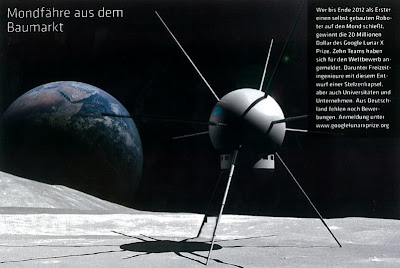
There was an article in the Die Zeit Wissen about the lack of German participation in the Google Lunar X PRIZE. This was first noted on The Launch Pad
You can download the full article in PDF format here. See translation below.
DYI Lunar Landers
Those who manage to build and land a robot on the moon by the end of 2012 will win the 20 Million Dollar Google Lunar X PRIZE. Ten teams have signed up so far.
Among them are the amateur engineers who designed the lander [pictured on the left] as well as university andindustrial participants.
There haven't been any German applications to enter the contest so far. Please apply at www.googlelunarxprize.org.
[Source: Die Zeit Wissen, 2008 (4), page 8]
The question is why has no German team stepped forward?
If there are German citizens that wish to join our upcoming European GLXP team please email us
Jul 24, 2008
First Art Exhibition in Outer Space
 Call for Space Art;
Tohoku University, Japan, is now developing a small satellite, named SPRITE-SAT, with launch planned for January 2009. The main mission of the satellite is a scientific study of lightening phenomena above the cloud layers but using this opportunity, they are also organizing the first art exhibition in outer space!
To take part in this exhibition you should submit monochrome digital pictures, which will be shrunk to a size of 1mm squares arranged as a mosaic on a silicon wafer fabricated using photolithography technology. The photolithography and etching process will be done on a standard silicon wafer, cut into a 3 cm by 3 cm piece, which will be exhibited in orbit attached on the top of an antenna boom on the top of the satellite. The artworks will also be exhibited on a special web page.
Submitting your artwork:
Please submit a digital drawing in 500×500 pixels, or a line drawing 500×500 pixels resolution. Black and white, no halftones. Submit as a digital file which can be displayed in 10 cm square on a computer screen.
Deadline of submission: August 10, 2008
Please send your submission or any questions to Prof. Kazuya Yoshida:
yoshida@astro.mech.tohoku.ac.jp
Jul 23, 2008
Japanese Lunar Exploration and the Google Lunar X PRIZE
How timely that I came across this Hyperbola blog post just after writing our own post on future government support for lunar exploration. It looks like the Japanese space agency JAXA shares many of the Google Lunar X PRIZE's visions for future use of the Moon.
But what a pity that the GLXP website has such a poor Japanese page. It appears that the site has little more than a translation of the main press releases and some information about the teams and key people. Furthermore, after exhaustive seraching we were unable to find a Japanese version of the GLXP promotional video - "Moon 2.0, Join the Revolution".
If the X PRIZE foundation and Google want to engage the large and affluent Japanese appetite for space-related issues they should really invest a bit more money in providing their content in the Japanese language.
But what a pity that the GLXP website has such a poor Japanese page. It appears that the site has little more than a translation of the main press releases and some information about the teams and key people. Furthermore, after exhaustive seraching we were unable to find a Japanese version of the GLXP promotional video - "Moon 2.0, Join the Revolution".
If the X PRIZE foundation and Google want to engage the large and affluent Japanese appetite for space-related issues they should really invest a bit more money in providing their content in the Japanese language.
Jul 22, 2008
The Moon in 3D
The concept of 3D video and television has been around for quite a while now, but it is slowly becoming a reality. Viewers in Japan can already receive an hour a day of 3D broadcasts, which can be viewed on special LCD TVs with polarized glasses.
Philips is even working on a system (WOWvx)to do away with the glasses, allowing the whole family to enjoy 3D images just the way we enjoy normal TV now!
But regardless of the way we view 3D images and movies, they have to be recorded first! And that generally means 2 cameras, with a spacing similar to the human eye, recording in sync. From this, 3D scenes can be rendered and, on the Moon, scientific data can be obtained (distances, crater depths etc.) opening up a whole new prospect for in-situ geology. Coupled with this, having a 3D image of the scene makes tele-operation of a lunar rover much more manageable.
Remember: this isn't like the Mars rovers with a little training, a human operator can get used to the delay and adapt to real-time operations on the lunar surface. So should we record the Moon in 3D? Definitely! After all, why take one camera, when you could take two!
Jul 21, 2008
Joke: Engineering Hell
(This is an oldy but a goody!)
An engineer dies and reports to the pearly gates. St. Peter checks his dossier and says, "Ah, you're an engineer -- you're in the wrong place."
So, the engineer reports to the gates of hell and is let in. Pretty soon, the engineer gets dissatisfied with the level of comfort in hell, and starts designing and building improvements. After awhile, they've got air conditioning and flush toilets and escalators, and the engineer is a pretty popular guy.
One day, God calls Satan up on the telephone and says with a sneer, "So, how's it going down there in hell?"
Satan replies, "Hey, things are going great. We've got air conditioning and flush toilets and escalators, and there's no telling what this engineer is going to come up with next."
God replies, "What??? You've got an engineer? That's a mistake -- he should never have gotten down there; send him up here."
Satan says, "No way. I like having an engineer on the staff, and I'm keeping him."
God says, "Send him back up here or I'll sue."
Satan laughs uproariously and answers, "Yeah, right. And just where are YOU going to get a lawyer?"
An engineer dies and reports to the pearly gates. St. Peter checks his dossier and says, "Ah, you're an engineer -- you're in the wrong place."
So, the engineer reports to the gates of hell and is let in. Pretty soon, the engineer gets dissatisfied with the level of comfort in hell, and starts designing and building improvements. After awhile, they've got air conditioning and flush toilets and escalators, and the engineer is a pretty popular guy.
One day, God calls Satan up on the telephone and says with a sneer, "So, how's it going down there in hell?"
Satan replies, "Hey, things are going great. We've got air conditioning and flush toilets and escalators, and there's no telling what this engineer is going to come up with next."
God replies, "What??? You've got an engineer? That's a mistake -- he should never have gotten down there; send him up here."
Satan says, "No way. I like having an engineer on the staff, and I'm keeping him."
God says, "Send him back up here or I'll sue."
Satan laughs uproariously and answers, "Yeah, right. And just where are YOU going to get a lawyer?"
Goverment Support for Future Lunar Missions
The recent post on the Space Prizes Blog makes an interesting point. Space agencies will probably need to show interest in using the lunar lander systems developed by GLXP teams otherwise investors will just not believe it is worth the effort developing lunar landers for a single mission.
Jul 20, 2008
Robotic Exploration Problem Featured in ICFP Contest
This year's ICFP Contest might help bring space-related AI challenges to the the attention of the programming languages community. The task of the contest is to deploy control software for a Martian lander and steer a rover from its starting position to its home base.
While the details of the task are abstracted from real deployment scenarios or even tongue-in-cheek, the fundamental idea is a point of very much debate and research. Increased autonomy of spacecraft and rovers is very much a multi-dimensional optimisation challenge in terms of science return and safety.
Communication with spacecraft increases in cost the further away the object is from Earth. On the other hand, the science instruments may detect interesting events that require timely action. The event might not be over before decision makers in mission control are able to update the schedule.
This is where increased autonomy might come into play. Of course, the safety of the mission must not be compromised by having the spacecraft issue commands that impact its own functioning. But science return might be increased significantly by identifying simply cases where the vehicle is allowed to deviate from its given schedule and return to normal operation after ad-hoc observation that were triggered by certain events.
Ideally, software tools should be adapted to quantify the benefits, impacts and drawbacks of such ideas. White Label Space hopes that the passionate participants of contests like this year's ICFP Contest help enlarge the pool of technologies from which the space community can draw their technologies.
Jul 17, 2008
The Social Value of Lunar Exploration
We were recently asked about our project's meaning to society. This is a good question that should be asked of any space-related activities beyond the obvious ones that directly serve people on Earth (telecommunications and remote sensing).
Our goal of sending a robotic lander to the Moon's surface has many benefits to society. Firstly, the desire to explore new territories is a theme embedded in all societies since the dawn of humanity. In the beginning exploration was by use of our own legs and then later by the legs of animals. In the last 2 millennia we began to use machines to aid our exploration - ships, cars, aircraft. Only in the last half of the 20th century did we start to explore space, first with machines and the later with humans.
We believe that our exploration of space is only just beginning, and indeed our current generation is sitting on the frontier of that exploration. We can choose to continue the bold visions of space exploration seen during the space race while those vision are still in our consciousness and in the memories of our parents generation. Alternatively, society can choose to turn its back on space exploration and focus its energies on the problems here on Earth. By sending a robotic craft back to the surface of the Moon we are saying that humanity's urge to explore will not end at the atmosphere and space near Earth. We see the return to the Moon as a way to remind society the benefits of space exploration.
Exploration of the Moon done with today's technologies should be cheaper in the sense that it places less burden on society. We would like to prove that by using modern technologies for engineering design, and the internet we can undertake a lunar surface mission at a fraction of the cost of the traditional space missions that are funded by governments. We would like to show that we can develop new technologies to meet these challenges, and that the technologies we develop will have benefits back on Earth as well as in space.
Another important benefit to society of our lunar mission will be the expansion of humanity's consciousness This will take place in many ways, scientifically, sociologically and artistically. When we go to the Moon we will take all of humanity with us. We will show them the stark beauty of the lunar surface in high definition imagery and videos. Also, we will show that small groups of motivated individuals can achieve extraordinary things that everyday life doesn't permit. Our lunar lander mission will pave the way for sending low-cost scientific missions to study the Moon up close, which has profound implications to the formation of the Earth and all life on it.
Our goal of sending a robotic lander to the Moon's surface has many benefits to society. Firstly, the desire to explore new territories is a theme embedded in all societies since the dawn of humanity. In the beginning exploration was by use of our own legs and then later by the legs of animals. In the last 2 millennia we began to use machines to aid our exploration - ships, cars, aircraft. Only in the last half of the 20th century did we start to explore space, first with machines and the later with humans.
We believe that our exploration of space is only just beginning, and indeed our current generation is sitting on the frontier of that exploration. We can choose to continue the bold visions of space exploration seen during the space race while those vision are still in our consciousness and in the memories of our parents generation. Alternatively, society can choose to turn its back on space exploration and focus its energies on the problems here on Earth. By sending a robotic craft back to the surface of the Moon we are saying that humanity's urge to explore will not end at the atmosphere and space near Earth. We see the return to the Moon as a way to remind society the benefits of space exploration.
Exploration of the Moon done with today's technologies should be cheaper in the sense that it places less burden on society. We would like to prove that by using modern technologies for engineering design, and the internet we can undertake a lunar surface mission at a fraction of the cost of the traditional space missions that are funded by governments. We would like to show that we can develop new technologies to meet these challenges, and that the technologies we develop will have benefits back on Earth as well as in space.
Another important benefit to society of our lunar mission will be the expansion of humanity's consciousness This will take place in many ways, scientifically, sociologically and artistically. When we go to the Moon we will take all of humanity with us. We will show them the stark beauty of the lunar surface in high definition imagery and videos. Also, we will show that small groups of motivated individuals can achieve extraordinary things that everyday life doesn't permit. Our lunar lander mission will pave the way for sending low-cost scientific missions to study the Moon up close, which has profound implications to the formation of the Earth and all life on it.
Jun 26, 2008
ARCA and The Future of Things
As you maybe heard in The Future of Things article, ARCA, an official GLXP team from Romania announced the upcoming launch of their Stabilo rocket. This declaration generated quite a hype on the net announcing the upcoming landing of the first contender of the GLXP on the Moon Surface.
But what should we think about it? Is really ARCA going to land on the moon and win the prize … in few weeks? Well, don't worry, the answer is a crystal clear : NO ! So what is happening?
In fact, if you read the GLXP website post you'll see that ARCA is really just launching its latest rocket, not the first GLXP launch but the last one of the original X PRIZE (the one that finished few year ago with the first private "space flight").Members of our team had the opportunity to meet and discuss with the ARCA representatives during the First GLXP Team Submit last May in Strasbourg (France). They explained then that the objective of the flight was to perform their first sub-orbital flight (so launch a rocket to few hundred kilometers of altitude) nothing like going to the moon.
If you have seen some of their videos or concepts, you might have been a bit surprised by their, shall we say, "unconventional approach" but bare in mind that those guys are really taking it seriously and manufacturing/launching hardware … It should be a source of respect and motivation. Like them, our team hopes to soon start advance tests and why not be the first on the moon!
But what should we think about it? Is really ARCA going to land on the moon and win the prize … in few weeks? Well, don't worry, the answer is a crystal clear : NO ! So what is happening?
In fact, if you read the GLXP website post you'll see that ARCA is really just launching its latest rocket, not the first GLXP launch but the last one of the original X PRIZE (the one that finished few year ago with the first private "space flight").Members of our team had the opportunity to meet and discuss with the ARCA representatives during the First GLXP Team Submit last May in Strasbourg (France). They explained then that the objective of the flight was to perform their first sub-orbital flight (so launch a rocket to few hundred kilometers of altitude) nothing like going to the moon.
If you have seen some of their videos or concepts, you might have been a bit surprised by their, shall we say, "unconventional approach" but bare in mind that those guys are really taking it seriously and manufacturing/launching hardware … It should be a source of respect and motivation. Like them, our team hopes to soon start advance tests and why not be the first on the moon!
Jun 15, 2008
Our Brand Image
To support our mission we will create a strong and independent brand image. To do this it will be important to highlight our differences from the other GLXP competitors.
Our brand image is:
- Knowledgable, Capable, Experienced (as space engineers)
- Motivated, Driven, Passionate
- Young
- Creative, Innovative, Original
- Dynamic
- International, Diverse
- Dream-driven
We will coordinate all our media activities to emphasize these aspects.
Jun 14, 2008
New Partnership with Wroclaw University of Technology
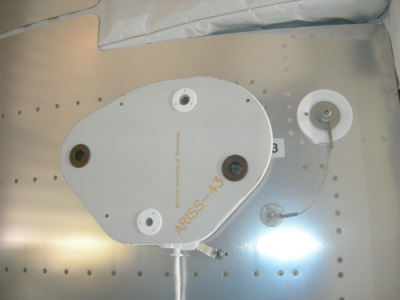
We are proud to announce that we have a new partner for the Communications Subsystem of our GLXP Lander! Wroclaw University of Technology's Institute of Telecommunications, Teleinformatics and Acoustics has extensive experience developing aerospace communications equipment including the Amateur Radio for the ISS (ARISS) antenna shown here mounted to the Columbus Module of the International Space Station.
Jun 8, 2008
Web Presence
Any GLXP business plan we can imagine will be fundamentally based around the team's website. Luckily our team includes many people with diverse backgrounds. In addition to the obvious space engineering & science types, we also have people experienced in web design, media, graphics and art.
We plan to implement our web presence with an incremental approach. As a first stage, during 2008 we used a Tumblr site to establish our initial web presence under the temporary name Thestor Cargo. Later we moved to this Blogger platform, which gives more features and has some very useful options for customization of the layout. In the future we will move to a more comprehensive tool such as Word Press for a fully featured website.
We plan to implement our web presence with an incremental approach. As a first stage, during 2008 we used a Tumblr site to establish our initial web presence under the temporary name Thestor Cargo. Later we moved to this Blogger platform, which gives more features and has some very useful options for customization of the layout. In the future we will move to a more comprehensive tool such as Word Press for a fully featured website.
Jun 1, 2008
Space Art:
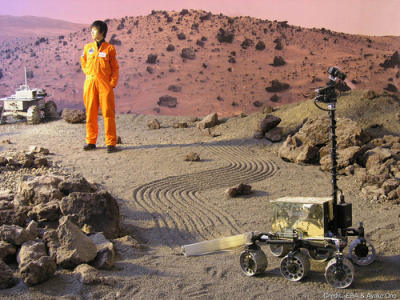
Since 1996 Ayako Ono has been exploring humanity's frontiers in the cosmos and imagination with her space art. The role of art is to stimulate the senses and imagination, broaden perceptions, and explore new perspectives. Sometime soon future generations will live far from the earth's surface. The resulting changes to the living environment will necessarily affect a radical transformation in common values. Space Art will help us prepare for the creation of these new values, and help answer the fundamental question of how human beings will evolve with these new values. In tackling this complex proposition, we will explore and invent new notions of beauty in cosmic space, through the interaction between various values systems.
May 30, 2008
The Swiss Propulsion Lab
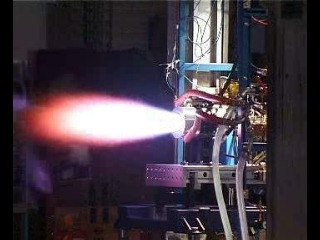 The Swiss Propulsion Laboratory (SPL) has extensive developing cheap and reliable rocket propulsion systems using non-toxic propellants.
SPL is supporting the design and testing of a new throttlable engine based on non-toxic propellants for our mission in Google Lunar X PRIZE (GLXP).
Below is a news story about SPL by Swiss broadcaster MTW.
***
May 27, 2008
Conceptual Design
Our IT infrastructure is also an important aspect of our conceptual design process since we are working in a distributed manner. As the design progresses we are developing spreadsheets for each subsystem. For the generation of our the system level budgets (e.g. mass, power, etc) we are using the J-CDS Concurrent Design Platform Platform to link together the relevant outputs from our subsystem spreadsheets together
The first step in our design process was to define the overall scope of the conceptual design study. The aim was to define the principal assumptions that will drive the detailed design of the subsystems.
Next the main design options for each subsystem were identified, in preparation for more detailed analysis of the various options.
That's about as far as we've got so far. The next step which is due to kick off this week will be to start the design, looping through the subsystems – starting with the issues that most drive the design - trajectory analysis, propulsion, lander and rover architectures, etc.
The first step in our design process was to define the overall scope of the conceptual design study. The aim was to define the principal assumptions that will drive the detailed design of the subsystems.
Next the main design options for each subsystem were identified, in preparation for more detailed analysis of the various options.
That's about as far as we've got so far. The next step which is due to kick off this week will be to start the design, looping through the subsystems – starting with the issues that most drive the design - trajectory analysis, propulsion, lander and rover architectures, etc.
May 25, 2008
Team Organization
Right from the beginning we realized that this would need a big team. Projects with unpaid team members are never easy, and landing a rover on the moon and sending back high quality video and photography is probably one of the most challenging volunteer projects ever attempted!
The first order of business was to tackle the IP issues. How can a distributed team of unpaid people be confident that they will get whatever rewards they are looking for from participation in such a project? Well, it wasn't easy but through lots of discussions we finally converged on a way to keep people motivated.
Also, early on we recognized the challenges with the information system. We investigated some different options but we eventually settled on using a wiki framework for keeping track of general discussions and an https secure web folders for our detailed documentation and larger files. We are continuously evaluating other options however, and we may later switch to other solutions or add new elements to our information system. Google Sites (http://sites.google.com) looks interesting and we are just starting to see if it will meet out needs.
The first order of business was to tackle the IP issues. How can a distributed team of unpaid people be confident that they will get whatever rewards they are looking for from participation in such a project? Well, it wasn't easy but through lots of discussions we finally converged on a way to keep people motivated.
Also, early on we recognized the challenges with the information system. We investigated some different options but we eventually settled on using a wiki framework for keeping track of general discussions and an https secure web folders for our detailed documentation and larger files. We are continuously evaluating other options however, and we may later switch to other solutions or add new elements to our information system. Google Sites (http://sites.google.com) looks interesting and we are just starting to see if it will meet out needs.
Apr 18, 2008
Pictures from the GLXP kick off meeting
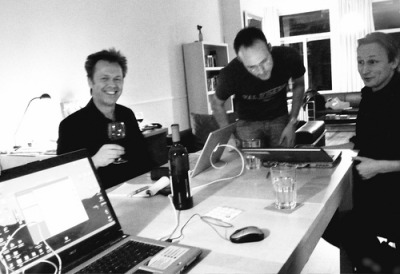
Google Lunar X PRIZE kick off meeting. In full discussion.

Group structure, approach & strategy was lively discussed

The web master, mid discussion on propulsion systems
Jan 1, 2008
Post PayPal Transaction Page
Small Business €100 Sponsorship:
Thanks for sponsoring White Label Space!
To show how you're sponsoring the next space race, feel free to ad this badge to your website:

To receive your customised certificate, email your PayPal transaction ID, business name (to appear on certificate), your business logo or a photo of your business/staff (smaller than 250kb) to:
sponsorship@whitelabelspace.com
If you would your name, logo/photo and message to appear on our website and promotional material, please confirm by emailing:
sponsorship@whitelabelspace.com
Thanks for sponsoring White Label Space!
To show how you're sponsoring the next space race, feel free to ad this badge to your website:
Note: the badge image should link to whitelabelspace.com
To receive your customised certificate, email your PayPal transaction ID, business name (to appear on certificate), your business logo or a photo of your business/staff (smaller than 250kb) to:
sponsorship@whitelabelspace.com
If you would your name, logo/photo and message to appear on our website and promotional material, please confirm by emailing:
sponsorship@whitelabelspace.com
***

Post PayPal Transaction Page
Individual €25 Sponsorship
Thanks for sponsoring White Label Space!
To show how you're sponsoring the next space race, feel free to ad this badge to your website:
To receive your customised certificate, email your email PayPal transaction ID, name (to appear on the certificate), and a photo (smaller than 250kb) to
sponsorship@whitelabelspace.com.
If you would your name, photo and message to appear on our website and promotional material, please confirm by emailing: sponsorship@whitelabelspace.com.
Thanks for sponsoring White Label Space!
To show how you're sponsoring the next space race, feel free to ad this badge to your website:
Note: the badge image should link to whitelabelspace.com
To receive your customised certificate, email your email PayPal transaction ID, name (to appear on the certificate), and a photo (smaller than 250kb) to
sponsorship@whitelabelspace.com.
If you would your name, photo and message to appear on our website and promotional material, please confirm by emailing: sponsorship@whitelabelspace.com.
***
Post PayPal Transaction Page
Individual €5 Sponsorship
Thanks for sponsoring White Label Space!
To show how you're sponsoring the next space race, feel free to ad this badge to your website:
If you would your name to appear on our website and promotional material, please email:
sponsorship@whitelabelspace.com.
Thanks for sponsoring White Label Space!
To show how you're sponsoring the next space race, feel free to ad this badge to your website:
Note: the badge image should link to whitelabelspace.com
If you would your name to appear on our website and promotional material, please email:
sponsorship@whitelabelspace.com.
***
Corporate and Mission Sponsors
Sponsor Something Historical and Unique: A Private Venture to the Moon
Your sponsorship of White Label Space can be leveraged in many innovative ways. The scientific, educational and publicity values are a few of the obvious. If you are interested in becoming a sponsor of White Label Space, or if you want to explore your sponsorship options, please contact us at: sponsorship@whitelabelspace.com
Corporate Sponsor
White Label Space is pushing the envelope when it comes to management, both of its own volunteer staff and the technology they're appropriating and designing in order to build the required hardware and software for private mission to the moon.
Being a corporate sponsor enables your company to affiliated and part of the White Label Space journey. Inspire your staff with what inspires us. Get on board. Contact us now.
Mission Sponsor
Are you a major brand that wants to make a real impact and outshine competitors?
Could you imagine your brand's products or services affiliated with a private mission to the moon as part of the Google Lunar X Prize? Then get in contact with us and we can detail how you can participate in the naming and sponsoring of hardware like our propriety moon lander and rover, plus events like rocket testing, the launch, the journey to the moon, the descent, the moon landing, the life of the lander, and journey of the rover.
Your sponsorship of White Label Space can be leveraged in many innovative ways. The scientific, educational and publicity values are a few of the obvious. If you are interested in becoming a sponsor of White Label Space, or if you want to explore your sponsorship options, please contact us at: sponsorship@whitelabelspace.com
Corporate Sponsor
White Label Space is pushing the envelope when it comes to management, both of its own volunteer staff and the technology they're appropriating and designing in order to build the required hardware and software for private mission to the moon.
Being a corporate sponsor enables your company to affiliated and part of the White Label Space journey. Inspire your staff with what inspires us. Get on board. Contact us now.
Mission Sponsor
Are you a major brand that wants to make a real impact and outshine competitors?
Could you imagine your brand's products or services affiliated with a private mission to the moon as part of the Google Lunar X Prize? Then get in contact with us and we can detail how you can participate in the naming and sponsoring of hardware like our propriety moon lander and rover, plus events like rocket testing, the launch, the journey to the moon, the descent, the moon landing, the life of the lander, and journey of the rover.
***
Team
The White Label Space core team includes the following talented individuals:
- Co-Founder and Chairman - Andrew Barton
- Co-Founder and Marketing Lead - Steve Allen
- Japan Team Leader - Takeshi Hakamada
- System Engineer - Jeremy Fielding
- Lead Engineer for Rover - Kazuya Yoshida
- Mechanical Designer - Aad Eggers
- Video Editor - Kristhian Mason
- Thermal Designer - Martin Lemmen
- Electrical Engineer - Jeroen van Straten
- Propulsion Engineer - Leo de Bolster
- PR Manager - Simon O'Reilly
- Rover/Lander Interface Manager - Andrea Gini
- Telecommunications Engineer - Carmen Felix
- Team Scientist - Mark Bentley
***
 White Label Space is a brandless space technology start-up founded by a team of international space professionals competing in the Google Lunar X PRIZE.
Together with our Partners we are creating the first ever "White Label" space mission - ready for the brand image of powerful sponsors with the vision and courage to create profound and enduring legacies by being part of the first privately funded effort to land on the moon. Every aspect of our GLXP mission, from the naming rights of our space vehicles to the suits worn in our clean rooms, is available for the messages of our sponsors.

Space exploration, and particularly lunar exploration, is on the verge of a new revolution of low cost ambitious missions. This revolution is fuelled by the frustration that humans haven't been to the moon in our lifetimes, and driven by the engine of the internet with all its possibilities for new media, communication and collaboration.
The majority of us work as space engineers, scientists and technologists. We know that the technology needed to go to the Moon is far less demanding than what exists in today's typical handheld electronic devices. The real challenge in the GLXP lies in linking humanity's natural urge to explore space with the financial forces that determine the efforts and energies expended in this world.
Our mission is to provide brandless space missions to anyone that has a viable business plan, taking the principles of Web 2.0 marketing & monetisation to the next level.
MORE About our GLXP Mission >>>
***
Investors
White Label Space is developing a first-of-kind space mission with a number of unique investment opportunities. In fact, developing innovative and scalable 'picks-and-shovels' type solutions is at the heart of White Label Space's plans for the Google Lunar X PRIZE.
The space industry is currently undergoing a transformation, whereby commercial industry is showing that it can provide key innovations faster and cheaper than governments. As has been the case throughout history, early investors will be the ones most likely to reap the benefits of these new markets.
If you would like more information on the available opportunities, please contact us at: investment@whitelabelspace.com
The space industry is currently undergoing a transformation, whereby commercial industry is showing that it can provide key innovations faster and cheaper than governments. As has been the case throughout history, early investors will be the ones most likely to reap the benefits of these new markets.
If you would like more information on the available opportunities, please contact us at: investment@whitelabelspace.com
***
Sponsors
Today the world's population consumes almost 70% of its information in digital format, and that consumption is mostly controlled by consumers who choose exactly what they want to watch in their limited time available. In previous years the marketer's challenge was to maximize the attention for ad time they purchased, but in today's on-demand world the marketer has to fight just to be played at all.
White Label Space produces exciting and inspirational and original content for the internet and other media that people want to watch - a perfect way to increase your brand's exposure or convey a marketing message!
White Label Space's highly qualified and capable team of space professionals is preparing for the most ambitious space project ever attempted without the direct assistance of governments. The general public is fascinated by space exploration and is eager to follow the team's challenge to explore the Moon's surface and beyond.
The team is looking for sponsors, big and small. The sponsors will receive extensive media exposure with an integrated marketing message tailored to their specific needs. The major sponsors will also have the option to purchase naming rights for our Google Lunar X PRIZE mission and its major elements.
If you are interested in becoming a sponsor of White Label Space, please contact us at: sponsorship@whitelabelspace.com
***
Subscribe to:
Posts (Atom)